Best CRM for manufacturing in 2026
Eight tools US shops actually evaluate, ranked for one specific buyer, with the bias stated before the ranking rather than buried after it.
Disclosure — read this first
This list is written by KanchanFlow. We rank ourselves first for our target buyer — US job shops, machine shops and contract manufacturers under roughly $50M revenue. If you are an enterprise multi-plant OEM, our picks 4 through 6 will fit you better.
We publish no review or rating structured data on this page, we give no scores out of ten, and every entry including our own carries a section on who should not buy it. Competitor capabilities are described as published by those vendors and dated. Last reviewed 2026-09-01. Reviewed quarterly.
In short
KanchanFlow is an RFQ-to-Order CRM for job shops and contract manufacturers, and this is our own ranking of eight manufacturing CRM and quoting tools. We place ourselves first for shops under roughly $50M revenue, state that bias openly, and give every entry an honest section on when not to pick it.
Method
Seven questions the ranking is built on
These are the questions that separate the tools in practice. Everything else — dashboards, email templates, integrations counts — is downstream of them.
| Criterion | The question it answers |
|---|---|
| RFQ handling | Does an inbound request become a structured record with line items, or a note on a deal? |
| Quoting depth | Is there a real cost buildup, or a price field and a PDF template? |
| Revision control | Can you show a buyer what changed between two revisions, without limits on history? |
| Order handoff | Does a confirmed order reach production as data rather than as retyping? |
| Mobile | Can an owner approve a quote from the shop floor, and can a rep capture offline? |
| Pricing transparency | Is the price published, and is the tier structure comprehensible? |
| Fit for shops under $50M | Is this built for a 25-person shop, or scaled down from an enterprise product? |
We weight RFQ handling and quoting depth most heavily, because for the buyer this list is written for, those two decide whether the software gets used after month three.
At a glance
The eight, in order
| # | Tool | Who it is for | Pricing |
|---|---|---|---|
| 1 | KanchanFlow | US job shops, machine shops and contract manufacturers, roughly 3 to 100 seats | Published: $39, $49 and $99 per user per month, three-user minimum, 14-day trial without a card |
| 2 | Paperless Parts | CNC machine shops and fabricators that want geometry-driven quoting speed | Not published publicly as of September 2026 — quoted per shop |
| 3 | MRPeasy | Small manufacturers who need light MRP, inventory and production scheduling in one place | Published per user per month with several tiers, as of their published pricing page, September 2026 |
| 4 | Salesforce Manufacturing Cloud | Enterprise and multi-plant manufacturers with an IT function and an existing Salesforce estate | Published per user per month at enterprise rates, as of their published pricing page, September 2026 |
| 5 | ECi JobBOSS² | Established job shops and machine shops that want one shop ERP covering quoting through the floor | Not published publicly as of September 2026 — quoted per shop |
| 6 | Zoho CRM | Manufacturers who want a broad, cheap, highly configurable general CRM and have someone willing to configure it | Published per user per month across four editions, as of their published pricing page, September 2026 |
| 7 | LeadSquared | Manufacturers whose main problem is high-volume inbound lead capture and speed to first contact | Published per user per month, as of their published pricing page, September 2026 |
| 8 | Xometry | Shops looking for demand rather than software | Marketplace commercial terms rather than a software licence |
The list
Eight entries, each with a reason not to buy it
- RANK 01Our own product — see the disclosure above
KanchanFlow
- Best for
- US job shops, machine shops and contract manufacturers, roughly 3 to 100 seats
- Pricing
- Published: $39, $49 and $99 per user per month, three-user minimum, 14-day trial without a card
Strengths
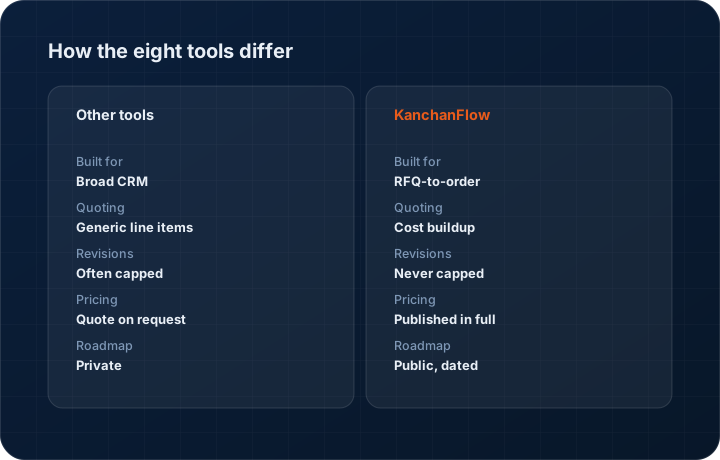
- The RFQ is a first-class record with unlimited line items and unlimited revision history on every tier, including the cheapest one
- Four-column cost buildup with margin guardrails and quantity breaks, built for estimators rather than for a sales pipeline
- Native iOS and Android apps with offline capture and push approvals, not a responsive website
- Pricing is published in full, including the add-on catalogue and the WhatsApp cost pass-through
Weaknesses
- We are new. Launched in 2026, no long production track record and no named public customers yet — the trust ladder we offer is a Delaware entity, a SOC 2 Type II audit, USA data centers, an open changelog and a public roadmap, not logos
- No production scheduling, inventory, MRP or shop-floor data collection, ever — you need an ERP alongside us
- No geometry-based automated quoting from a CAD file, and none planned
- Smaller integration catalogue than the incumbents, and no SAP or Oracle connector outside an Enterprise add-on
When not to pick this
Do not pick us if you want one system to run both the front office and the shop floor, if your quoting is genuinely automated from geometry today, if you are an enterprise multi-plant OEM already standardised on SAP or Oracle, or if you need a vendor with a decade of references. All four are legitimate reasons to buy something else, and we would rather you did than churned in month four.
- RANK 02
Paperless Parts
- Best for
- CNC machine shops and fabricators that want geometry-driven quoting speed
- Pricing
- Not published publicly as of September 2026 — quoted per shop
Strengths
- Genuinely strong at fast quoting for machining and sheet metal, with geometry analysis doing work an estimator would otherwise do by hand
- Built specifically for shops rather than adapted from a generic CRM, and it shows in the vocabulary and the workflow
- Good customer-facing portal experience for buyers submitting RFQs
- Strong reputation among shops that have adopted it, particularly for reducing quote turnaround
Weaknesses
- Pricing is not published, which makes budgeting a sales conversation rather than a decision
- Geometry-driven quoting is strongest on well-characterised processes and less useful on complex assemblies, weldments with heavy fit-up, or engineer-to-order work
- It is a quoting system first; the wider customer relationship, channel and order-to-cash side is thinner
When not to pick this
Do not pick it if most of your work is assemblies, weldments or ETO projects where geometry tells you little, if you need a published price before you will take a call, or if your core problem is follow-up discipline and channel management rather than quote speed.
- RANK 03
MRPeasy
- Best for
- Small manufacturers who need light MRP, inventory and production scheduling in one place
- Pricing
- Published per user per month with several tiers, as of their published pricing page, September 2026
Strengths
- Real production capability at a small-business price: bills of material, routings, scheduling, stock and purchasing
- Published, comprehensible pricing and a self-serve trial
- Good fit for a maker or small production manufacturer with a stable product catalogue
- Covers ground we deliberately do not: the actual floor
Weaknesses
- The CRM and quoting side is the lighter half of the product — RFQ handling and cost buildup depth are not its centre of gravity
- Better suited to repeat production against a catalogue than to one-off RFQ work where every quote starts from a print
- Quote revision history and diff comparison are not the strength a job shop needs them to be
When not to pick this
Do not pick it if your business is one-off RFQ work with forty inbound requests a week, if quoting depth is your bottleneck, or if you already run a shop ERP and only need the customer-facing half.
- RANK 04
Salesforce Manufacturing Cloud
- Best for
- Enterprise and multi-plant manufacturers with an IT function and an existing Salesforce estate
- Pricing
- Published per user per month at enterprise rates, as of their published pricing page, September 2026
Strengths
- The strongest option on this list for multi-plant, multi-entity account management, forecasting and sales agreements
- Enormous ecosystem: if a connector exists anywhere, it probably exists here
- Serious enterprise controls — governance, permissions, audit, data residency options
- Sales agreement and run-rate forecasting genuinely fit large contract manufacturing relationships
Weaknesses
- It is not a quoting system for shop work out of the box. Cost buildup for a machined part is an implementation project, not a feature
- Total cost is licence plus implementation plus an administrator, which is a different order of magnitude from anything else on this list
- Time to value is measured in quarters
When not to pick this
Do not pick it if you are a 25-person shop with no IT staff, if you need to be quoting inside a fortnight, or if the honest problem is that RFQs sit unread for three days — an enterprise CRM does not fix an estimating bottleneck.
- RANK 05
ECi JobBOSS²
- Best for
- Established job shops and machine shops that want one shop ERP covering quoting through the floor
- Pricing
- Not published publicly as of September 2026 — quoted per shop
Strengths
- A long track record in exactly this market; the vocabulary and the workflow come from real shops
- One system from estimate through scheduling, shop-floor data collection, inventory and job costing
- Job costing against actuals is a genuine strength and something a CRM cannot do
- Multi-plant capability for shops that have grown into a second location
Weaknesses
- Front-office capabilities — multi-channel RFQ intake, follow-up cadence, quote ageing, mobile approvals — are the weaker half
- Pricing is not published, and implementation is a project rather than a signup
- Shops commonly report that the estimating module is capable but that quoting discipline still happens in spreadsheets alongside it
When not to pick this
Do not pick it if you already have an ERP you are not replacing, if your problem is the three days before an estimator opens the RFQ rather than the shop floor, or if you need a decision this quarter with a published price.
- RANK 06
Zoho CRM
- Best for
- Manufacturers who want a broad, cheap, highly configurable general CRM and have someone willing to configure it
- Pricing
- Published per user per month across four editions, as of their published pricing page, September 2026
Strengths
- Very low entry price and a large surrounding suite covering accounting, inventory, support and forms
- Deeply customisable — custom modules, fields and workflows can model an RFQ if you build it
- Strong administrative and multi-entity controls at the upper editions
- Excellent value if your requirement is genuinely a general CRM
Weaknesses
- Nothing manufacturing-specific ships in the box. An RFQ, a cost buildup and a revision diff are all things you build
- Configuration debt is real: the shop that customises it heavily owns that customisation forever
- Quoting is a document generator, not a cost buildup with margin guardrails
When not to pick this
Do not pick it if you have no internal person who will own the configuration, if you need estimating depth rather than a flexible database, or if you have already tried to model RFQ revisions in a general CRM and found the revision history is where it fell apart.
- RANK 07
LeadSquared
- Best for
- Manufacturers whose main problem is high-volume inbound lead capture and speed to first contact
- Pricing
- Published per user per month, as of their published pricing page, September 2026
Strengths
- Strong lead capture, routing and speed-to-lead automation across many inbound channels
- Good mobile field-sales tooling for teams doing high-volume outside sales visits
- Sensible option where a manufacturer runs marketplace listings and paid campaigns at volume
Weaknesses
- It is a sales-velocity CRM, not a manufacturing system. There is no cost buildup, no revision control and no order handoff to production
- Designed around a lead-to-deal motion rather than an RFQ-to-order motion
- A shop that adopts it for quoting will end up quoting in a spreadsheet anyway
When not to pick this
Do not pick it if the work you win is decided by estimating quality and quote turnaround rather than by contact speed, or if you need any part of the record after the quote is sent.
- RANK 08
Xometry
- Best for
- Shops looking for demand rather than software
- Pricing
- Marketplace commercial terms rather than a software licence
Strengths
- A genuine source of work for shops with spare capacity, particularly machining and sheet metal
- Removes the sales function entirely for the jobs it supplies
- Useful for filling gaps in a schedule without a business development effort
Weaknesses
- It is a marketplace, not a CRM. You get demand, not a system of record
- You do not own the customer relationship, and the pricing is not yours to set
- Margins on marketplace work are typically thinner than on direct work, and dependence on it is a strategic risk
When not to pick this
Do not pick it as a substitute for a quoting system, and be careful about picking it as a substitute for direct sales. It belongs on this list because shops genuinely evaluate it against buying software, and it deserves an honest entry rather than being left off.
How to choose
One question, then a shortlist of two
Work out whether the money is being lost before or after the quote is priced. Look at two numbers: your median hours from RFQ received to quote sent, and your on-time delivery percentage. If the first number is bad and the second is fine, your problem is the front office. If the second is bad, your problem is the floor and no CRM on this list will fix it.
Then shortlist two and trial both properly with real RFQs, not sample data. Take three recent requests — one repeat part, one new part from a known customer, one awkward enquiry you would normally no-bid — and run all three through each system end to end. Two weeks of that tells you more than six vendor demonstrations.
Last thing, and it is the one shops most often skip: ask each vendor to tell you who should not buy their product. A vendor who cannot answer that question either does not know their own boundaries or is not going to tell you where they are.
What this is not
We are not built for enterprise multi-plant OEMs on SAP or Oracle, process manufacturers on recipe-based batching, distributors who need a warehouse management system, or shops requiring HIPAA / FDA validation. If that is you, Salesforce Manufacturing Cloud, NetSuite, or Global Shop Solutions is a better fit.
Questions about this list
You should not trust the ranking. You should read the reasoning and the when-not-to-pick-this sections, including ours, and decide for yourself. We think a self-published list with the bias stated plainly at the top is more useful than one that pretends to be neutral. Every entry here, including our own, carries specific weaknesses and a section saying who should not buy it.
Head-to-head comparisons
KanchanFlow vs MRPeasy
Front office against light MRP, with a table and an honest where-they-beat-us section.
Read moreKanchanFlow vs JobBOSS
CRM against shop ERP, and why most shops end up running both.
Read moreKanchanFlow vs Zoho CRM
Manufacturing-specific against configurable general CRM.
Read moreJob shop CRM
The buyer this list is written for, described in detail.
Read morePricing
Our published prices, the add-on catalogue and the ceiling policy.
Read moreWhat is shipping today
The feature truth audit: live, beta, building and merely planned.
Read moreSee a live quote draft built from a real RFQ
Fourteen days, no credit card, sample data pre-loaded. If it does not fit your shop, we will tell you in the first call.
- Delaware LLC
- SOC 2 Type II
- USA Data Centers (AWS)