Engineer-to-order software for a quote that is itself a project
When a bid takes three weeks of engineering, costs $12,000 to produce and wins one time in five, the front end of the business needs managing as carefully as the build.
In short
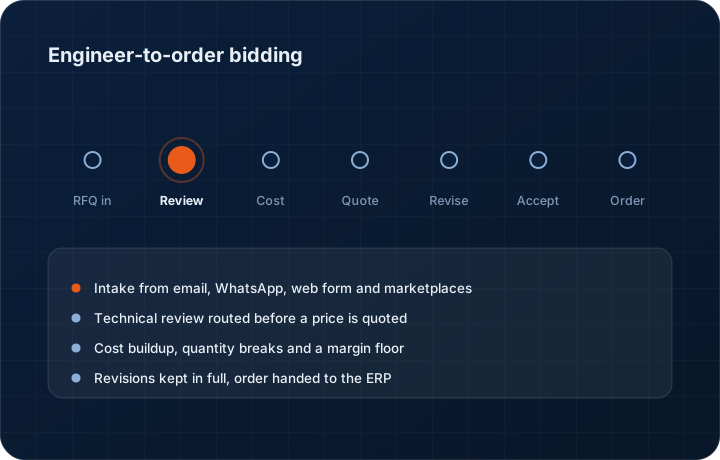
KanchanFlow is an RFQ-to-Order CRM for engineer-to-order manufacturers. It treats a bid as a project with its own cost: engineering hours are logged against the RFQ, assumptions and exclusions are structured records carried into every revision, and revision history is unlimited across a negotiation that may run a year.
An engineer-to-order business has a problem a job shop does not: the quote is expensive. Producing a credible bid for a custom machine, a process skid or a special-purpose handling system means an engineer sketching a layout, a preliminary bill of material, four vendor enquiries for long-lead items, and a controls estimate. Three weeks of real work, most of which is spent on projects you will not win.
Every other problem in an ETO front end follows from that. Bid selection matters more than price. Exclusions matter more than inclusions. And a negotiation that runs nine months will outlast the memory of everybody involved unless it is on a record.
Why ETO is different
Four numbers that change how the front end works
These are the structural facts of an engineer-to-order business, and they are why a standard sales pipeline fits it badly.
- Quote duration
- 2 to 6 weeks
- A job-shop quote takes hours. An ETO quote takes an engineer, a layout, a preliminary BOM and a vendor package.
- Estimating cost
- $4k to $30k
- Real engineering hours go into a bid you may not win. Untracked, this is the largest uncosted expense in an ETO business.
- Win rate
- Often 15 to 30 percent
- Which means four bids are paid for by every one that lands. Bid selection is the commercial decision, not price.
- Negotiation length
- 3 to 12 months
- Across which the scope changes repeatedly and the person you are talking to may change twice.
The bid package
Eight things an ETO quote carries
Each one is a structured part of the quote record, not a paragraph somebody rewrites for every proposal.
| Element | What it holds |
|---|---|
| Scope statement | What is included, stated positively |
| Exclusions list | What is not included — the single most valuable page in an ETO quote |
| Assumptions register | Site power, foundation, access, customer-supplied items, approvals |
| Preliminary BOM | Major assemblies and long-lead items, priced or budgeted |
| Vendor quote pack | Bought-out items with the vendor, validity date and quoted price held per line |
| Engineering hours estimate | Design, drafting, controls, commissioning, split by discipline |
| Milestone payment schedule | Deposit, drawing approval, factory acceptance, delivery, commissioning |
| Terms, escalation and validity | Especially the material escalation clause on a nine-month delivery |
The exclusions list earns its place at the top of that table. Most ETO disputes are about something nobody said out loud, and the cheapest moment to say it is in the quote.
Cost of estimating
What a bid actually costs you
Log the hours against the bid, not into overhead. The number changes what you choose to bid on.
- Hours logged against the bid — Engineering, drafting and estimating time booked to the RFQ record rather than absorbed into overhead.
- Vendor quote effort — Chasing four vendors for a long-lead item is real work. It is logged so bid cost is not understated.
- Cost per bid, by customer — After a year this tells you which customers are expensive to bid for and which convert.
- Cost of bids lost — The number nobody wants to see and everybody should. It is the budget for being more selective.
A worked example. A builder of custom conveyor systems bids 42 projects a year at an average of 90 engineering hours each. At a loaded $95 an hour that is roughly $360,000 of selling cost, of which about $290,000 is spent on the 33 bids that do not land. When that number becomes visible, the conversation stops being about win rate and becomes about which enquiries deserve a full bid, which deserve a budgetary number, and which deserve a polite decline.
Revision control
Six things that move during a long negotiation
- Scope creep arriving as a casual email — can you also include the guarding?
- A specification revision from the customer's engineer mid-negotiation
- A vendor quote expiring before the customer decides, changing your cost base
- Material escalation across a six-month decision window
- A change of buyer, who reopens commercial terms you had settled
- A budget cycle that moves the whole project one quarter to the right
Each of these produces a revision, and each revision needs a diff a customer can see. When a project that was quoted in March is signed in November at a different number, the chain of revisions is the explanation — the guarding you added, the specification change their engineer issued, the escalation clause that moved the steel.
Vendor quote validity is the trap specific to ETO. A long-lead gearbox quoted in April with a 60-day validity is not a cost you still hold in September. Each bought-out line carries its vendor, quoted price and validity date, and expired vendor pricing is flagged on the quote before it is re-issued.
Boundaries
What we are not, for an ETO business
What this is not
We are not built for enterprise multi-plant OEMs on SAP or Oracle, process manufacturers on recipe-based batching, distributors who need a warehouse management system, or shops requiring HIPAA / FDA validation. If that is you, Salesforce Manufacturing Cloud, NetSuite, or Global Shop Solutions is a better fit.
No engineering BOM with effectivity and change orders. No resource-loaded project schedule. No earned-value or percentage-of-completion reporting. No CAD, no PLM, no document control system for approval drawings. An ETO business of any size needs a project-based ERP for those, and we are designed to sit in front of one rather than replace it.
Questions from engineer-to-order builders
Neither in the usual sense. It is the front end of an ETO business — the bid, the estimating effort, the assumptions and exclusions, the revisions and the negotiation. It is not project manufacturing, it does not carry a multi-level engineering BOM, it does not do resource-loaded project scheduling, and it does not run earned-value reporting. Those live in a project-based ERP. If you need one, buy one, and connect it to this.
Related reading
Custom manufacturing CRM
The ICP page for custom and ETO builders, with the pain and the workflow mapping.
Read moreQuote management software
Running a book of long-cycle quotes: ageing, cadence, expiry and win/loss.
Read moreManufacturing quoting software
The four-column buildup and how bought-out vendor lines are held.
Read moreApproval engine
Value thresholds and margin rules on a six-figure bid.
Read moreQuote revision diff
The diff view across a twelve-revision negotiation.
Read moreQuote to cash
Where an ETO order hands off to a project-based ERP.
Read moreSee a live quote draft built from a real RFQ
Fourteen days, no credit card, sample data pre-loaded. If it does not fit your shop, we will tell you in the first call.
- Delaware LLC
- SOC 2 Type II
- USA Data Centers (AWS)