Quote to cash in a job shop, and the four places it breaks
Eleven stages from the RFQ email to the payment. We own seven of them and are precise about which seven.
In short
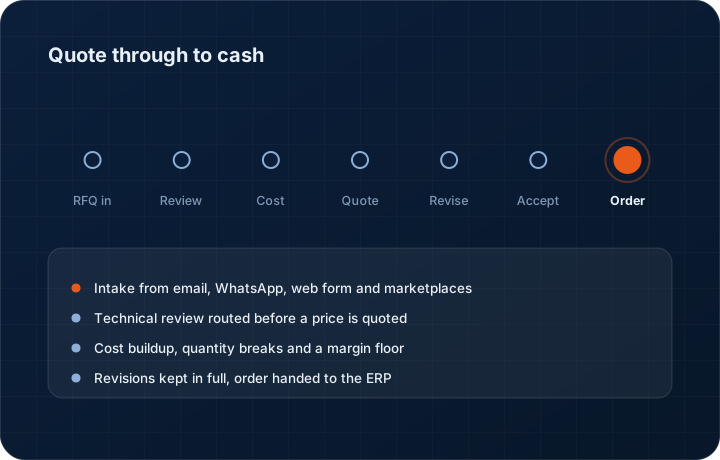
KanchanFlow is an RFQ-to-Order CRM that covers the front seven stages of the quote-to-cash cycle for job shops and contract manufacturers — intake through order handoff — then passes the confirmed order to your ERP and accounting system. It is deliberately not an ERP, and it does not raise invoices.
Quote to cash is a phrase that arrived in manufacturing from enterprise software, where it usually means a suite that swallows the whole cycle. In a 30-person shop that is not a realistic proposition and rarely a desirable one. You already have an ERP or a job-tracking system that runs your floor, and an accounting system your accountant will not give up.
The useful question is not which single system owns the cycle. It is where the cycle loses money, and the answer is almost always at the handoffs — between quote and PO, between PO and order, between order and invoice, and between invoice and the next quote you send to an account that is not paying.
The eleven stages
Who owns what
An honest ownership map. If a stage says your ERP, we do not do it and we are not planning to.
| Stage | Owner | What happens |
|---|---|---|
| 1. RFQ received | KanchanFlow | Multi-channel intake, routing, qualification, the response clock |
| 2. Estimate | KanchanFlow | Four-column cost buildup, quantity breaks, similar-part history |
| 3. Quote issued | KanchanFlow | Quote document, validity window, terms, send with read receipt |
| 4. Negotiation and revisions | KanchanFlow | Unlimited revisions with a diff view, approval engine on exceptions |
| 5. Acceptance | KanchanFlow | E-signed acceptance locks the accepted revision |
| 6. Purchase order | KanchanFlow | PO capture, line-for-line match against the accepted quote, mismatch resolution |
| 7. Order handoff | KanchanFlow to ERP | Confirmed order pushed by connector or webhook; milestones come back |
| 8. Production | Your ERP or job tracking | Scheduling, routings, work in process, inventory — not us |
| 9. Dispatch | Your ERP, milestones visible here | Ship date, freight, delivery risk flags on the customer record |
| 10. Invoice | Your accounting system | Raised from the accepted order data we hand across the connector |
| 11. Collection | Your accounting system | Payment status read back so sales can see an account on hold |
The break points
Four handoffs where the money goes
Each one is a place where information is retyped, and every retyping is a chance to lose a line.
- The gap between quote and PO — A quote is accepted verbally, the PO arrives eleven days later with a different quantity, and nobody compares them until the parts are cut.
- The gap between PO and order — A PO is re-keyed into the ERP by hand. One transposed quantity or one missed revision letter costs a run.
- The gap between order and invoice — The invoice is raised from the PO rather than the accepted quote revision, so an agreed expedite charge or tooling line never gets billed.
- The gap between invoice and cash — Sales does not know an account is on hold, keeps quoting, and the shop takes work it will not be paid for on time.
The common factor is that each handoff is between two people who both assume the other checked. The fix is not more diligence, it is having one record that carries through: a quote revision that is locked at acceptance, a PO matched against that locked revision, and an order pushed to the ERP from the matched result rather than typed from the PDF.
There is a fifth leak that is not a handoff at all. It happens at stage two, when a standard price goes out to an account that negotiated a lower one, or when an agreement that expired in June is still being honoured in November because nobody was watching the date. Contract and customer price lists hold the negotiated price against the account with the dates it runs between, so the estimate reads the agreement before it reads the cost buildup. That work is in development against Wave 1 Milestone 4.
Revenue Leakage Dashboard
Six numbers that measure the cycle
Each metric points at a specific recoverable loss and links to the list of records causing it. Starter shows three of the six, Professional all six.
- Quotes never followed up
- Count + value
- The single largest recoverable loss in most shops. An open quote past its follow-up date with no contact logged.
- Quotes expired unconverted
- Count + value
- The validity window closed while the quote was still live and nobody re-issued it.
- Margin given away
- Quoted vs floor
- Lines shipped below the margin floor, broken out by estimator and by customer.
- Repeat parts not requoted
- Parts + last price
- Repeat work still priced off a costing built before the last material move.
- Dormant accounts
- Accounts + last order
- Customers whose order rhythm has broken and nobody noticed.
- RFQ response lag
- Median hours
- Time from RFQ received to quote sent, by estimator and by channel.
A worked cycle
One order, forty-one days
A stainless bracket assembly, 250 pieces, from a contract customer who has bought from you twice before. Day zero: the RFQ arrives by email with a Rev C print and a target date. Routing sends it to the fabrication estimator inside a minute because the material callout is 304 and the process plan involves welding.
Day one: the buildup goes together in two hours, helped by the similar-part search surfacing the same bracket family quoted eight months ago at a known material cost. The Quote Risk scan flags a missing passivation line — the print calls for it, the buildup does not. That single flag is worth about $4 a part.
Day two: quote sent. Day nine: the buyer asks for a 100-piece price. Rev 1 goes out with the break table. Day fourteen: buyer asks for a two-week pull-in. Rev 2 adds an expedite line, which breaches the lead-time rule, so the approval engine routes it to the owner, who approves from the phone in the aisle.
Day nineteen: acceptance signed on Rev 2. Day twenty-six: PO arrives quoting 250 pieces at the Rev 1 price. The match raises it, a phone call resolves it, a corrected PO follows. Day twenty-eight: order pushed to the ERP with the Rev 2 line items. Day forty-one: dispatch milestone comes back, invoice raised from the accepted order.
Without the match at day twenty-six, that shop ships 250 brackets at a price that does not include the expedite it agreed to. That is the whole argument for treating quote to cash as one connected record rather than four systems and a habit of trusting people.
Boundaries
What we do not touch
What this is not
We are not built for enterprise multi-plant OEMs on SAP or Oracle, process manufacturers on recipe-based batching, distributors who need a warehouse management system, or shops requiring HIPAA / FDA validation. If that is you, Salesforce Manufacturing Cloud, NetSuite, or Global Shop Solutions is a better fit.
Questions about quote to cash
No, and any vendor claiming to be one for a job shop is describing an ERP. We own stages one through seven — RFQ, estimate, quote, revisions, acceptance, purchase order and order handoff. Production, inventory and dispatch belong to your ERP or job-tracking system. Invoicing and collection belong to your accounting system. What we do is make sure the data crossing those boundaries is the accepted quote revision rather than somebody's retyping.
Related reading
Quote to order
The front half in detail: acceptance, e-signature, PO matching and the ERP handoff.
Read moreQuote management software
Running the open quote book: ageing, follow-up cadence, expiry and win/loss.
Read moreManufacturing quoting software
The cost buildup that produces the quote in stage two.
Read moreRevenue Leakage Dashboard
The six metrics with their definitions and drill-through record lists.
Read moreContract and customer price lists
Negotiated prices with effective dates, read before the cost buildup at stage two.
Read morePO OCR and matching
How a customer PO is read and compared to the accepted quote revision.
Read moreAll integrations
Accounting and ERP connectors with last-tested dates.
Read moreSee a live quote draft built from a real RFQ
Fourteen days, no credit card, sample data pre-loaded. If it does not fit your shop, we will tell you in the first call.
- Delaware LLC
- SOC 2 Type II
- USA Data Centers (AWS)