RFQ management software built for shops that quote for a living
Every request for quote, from every channel, on one structured record with a clock on it. Built for the shop that sees forty RFQs a week and two estimators to price them.
In short
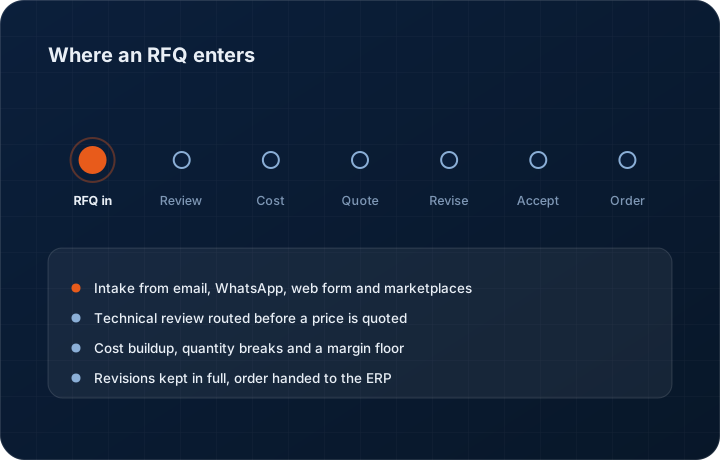
KanchanFlow is an RFQ-to-Order CRM for job shops and contract manufacturers. It captures every request for quote from email, WhatsApp, your web form and marketplaces into one structured record with unlimited line items on every tier, routes it to the estimator who can price it, and tracks the response clock from arrival to signed order.
An RFQ is not a lead. A lead is a name and a phone number. An RFQ is a print, a quantity, a material callout, a tolerance you may or may not be able to hold, and a due date the buyer will not move. Treating it as a line in a sales pipeline is why most shops end up quoting out of a shared inbox and a spreadsheet that one person maintains.
The measurable problem is response time. In the work we have seen, the shop that gets a complete quote back inside a day is on the short list; the shop that takes four days is answering a decision that was already made. The RFQ itself is rarely the bottleneck. The bottleneck is that the RFQ sat unread, went to the wrong estimator, or was missing one piece of information nobody chased.
Intake
Four channels, one record
Buyers do not send RFQs the way a software vendor would like. Intake reads the four places they actually arrive and produces the same structured record from each.
- Estimating inbox
- Email + attachments
- quotes@ or estimating@ forwards in. The body, the PDF drawing, the spreadsheet BOM and the buyer signature all land on one RFQ record.
- Photo of a print
- A buyer sends a phone photo of a drawing at 6:40pm. It becomes an RFQ with the image attached and the thread linked, not a message someone forgets to forward.
- Web form
- Structured fields
- Your site form maps straight to RFQ fields — part, quantity, material, target date, tolerance notes — with the uploaded file kept.
- Marketplace
- Portal enquiries
- Enquiries pulled from marketplace lead feeds arrive as RFQs with the source stamped, so you can measure which channel actually converts.
Each record keeps the original — the raw email body, the attached PDF, the WhatsApp image — alongside the structured fields. When a buyer disputes what was asked for six weeks later, the source document is on the RFQ, not in a mail client belonging to somebody who has since left.
The record
What an RFQ actually holds
Nine fields decide whether an RFQ turns into a quote quickly or turns into a week of back and forth.
| Field | How it is filled | Why it matters |
|---|---|---|
| RFQ number and received timestamp | Auto | The clock that your response-time metric is measured against |
| Source channel | Auto | Email, WhatsApp, web form or marketplace — stamped, not guessed |
| Customer, plant and requester | Matched | Linked to the account record, or flagged as a new prospect |
| Line items: part, qty, material, process | Extracted + confirmed | Unlimited lines on every tier, including Starter |
| Drawing and revision referenced | Manual or OCR | So a Rev C quote is never priced against a Rev B print |
| Target date and target price | Extracted | Both drive the qualification score |
| Open technical questions | Manual | The questions back to the buyer, with the clock on each |
| Assigned estimator | Rules | By material, process, part envelope or named customer |
| No-bid reason | Manual | Recorded, because a no-bid you cannot explain repeats itself |
We never cap RFQ line items. A 400-line RFQ costs the same as a four-line one on Starter, Professional and Enterprise. Capping line items would be charging you for the exact work you bought the software to handle.
Routing
Send the RFQ to the person who can price it
Routing rules run on the properties of the work, not on whose turn it is.
- By process — 5-axis work to the estimator who quotes 5-axis, stainless weldments to the fab estimator, turned parts to the lathe cell lead.
- By part envelope — Anything over your table travel or past your bar capacity gets flagged before an estimator spends an hour on a job you cannot hold.
- By customer — Named accounts route to the person who knows their print conventions, their PPAP expectations and their buyer.
- By completeness — Missing tolerance, missing quantity, missing material spec or missing print — parked in a queue with the question already drafted back to the buyer.
The gaps this closes
- An RFQ that arrived Friday afternoon and surfaced the following Wednesday
- Two estimators quoting the same RFQ because it was forwarded twice
- A quote priced off Rev B when the buyer attached Rev C
- A no-bid that was never communicated, so the buyer stopped sending work
- A 90-line RFQ split across three emails and quoted as three unrelated jobs
- An RFQ with no owner because the estimator who received it was on vacation
Response time
The clock is the metric
Every RFQ carries a timestamp from arrival. The median hours from RFQ received to quote sent is reported by estimator, by channel and by customer.
Intake to assignment
How long an RFQ waits before it has an owner. In most shops this is the largest single block of the total, and it is the easiest to remove — routing rules do it in seconds rather than at the next morning huddle.
Assignment to priced
Real estimating time. This is the number you want to protect. Similar-part search shortens it by putting the last accepted cost for a comparable part in front of the estimator before they start from an empty grid.
Priced to sent
Approval and document assembly. Where an owner has to sign off a margin exception, the approval engine routes it rather than leaving the quote parked on a desk until Thursday.
The RFQ response lag metric sits on the Revenue Leakage Dashboard next to quotes never followed up and quotes expired unconverted. Those three together usually account for more lost revenue in a job shop than any pricing decision.
Qualification
Not every RFQ deserves an estimator
A two-estimator shop that receives forty RFQs a week cannot price forty RFQs a week properly. The choice is not whether to filter, it is whether you filter deliberately or by whichever one is on top of the pile.
The RFQ Qualification agent scores each incoming request against the work you actually win — part family, process, quantity band, customer history, target price against your realised prices on comparable work. The score is a suggestion on a record, not a decision. An estimator still decides. But it means the 250-piece repeat from a customer with a 60 percent win rate does not sit behind a one-off prototype from a buyer who has never placed an order.
Where the score says no-bid, you record the reason and send the buyer a short, honest decline. Shops that do this consistently report the opposite of what they expect: the buyers keep sending work, because a fast no is more useful to a purchasing agent than a slow maybe.
Boundaries
Where RFQ management stops
What this is not
This is not an ERP, MRP, CAD, BOM, or advanced CPQ system — it manages customer RFQs, quotes, follow-ups, and order handoff.
We do not interpret GD&T, we do not check manufacturability, and we do not tell you what a part should cost. An estimator with twenty years on the floor knows what the setup takes on your machines with your people. The software carries the record, the clock, the history and the arithmetic, and it keeps the last accepted price for a similar part where you can see it.
Questions estimators ask about RFQ software
A generic CRM stores a deal with an amount and a close date. RFQ management software stores the request itself — every line item with its part number, quantity, material, process, tolerance note and drawing revision — and tracks the clock from the moment it arrived. In a job shop the deal is not one number, it is forty lines that each need pricing, and the difference between winning and losing is usually hours rather than salesmanship.
Related reading
Manufacturing quoting software
What happens after intake: four-column cost buildup, quantity breaks and margin guardrails.
Read moreQuote to order
Revisions, e-signed acceptance, PO matching and the handoff to your ERP.
Read moreRFQ management feature detail
The feature page with the current shipping status and screen-by-screen detail.
Read moreMulti-item RFQ handling
How a 400-line RFQ is priced, revised and sent without splitting it.
Read moreWhat is an RFQ in manufacturing?
Definition, the fields a complete RFQ carries, and how it differs from an RFI or an RFP.
Read moreCut RFQ response time to three hours
Where the three days actually go, stage by stage, and what to fix first.
Read moreSee a live quote draft built from a real RFQ
Fourteen days, no credit card, sample data pre-loaded. If it does not fit your shop, we will tell you in the first call.
- Delaware LLC
- SOC 2 Type II
- USA Data Centers (AWS)