KanchanFlow vs JobBOSS
A shop ERP and an RFQ-to-Order CRM are not substitutes. The honest question is which half of your shop is losing money, and most shops that answer it properly end up running both.
In short
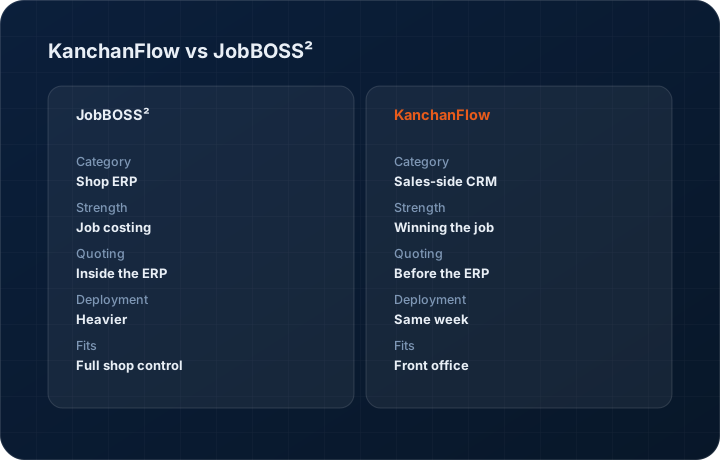
KanchanFlow is an RFQ-to-Order CRM covering intake, estimating, quoting, revisions and order handoff. ECi JobBOSS² is a shop ERP covering estimating through scheduling, shop-floor data collection and job costing. We hand the confirmed order to systems like it, and we are not building production features.
JobBOSS² has been serving job shops and machine shops for a long time and does a job we have deliberately declined to attempt. Everything here is written on that basis, and competitor capabilities are described as published by that vendor, September 2026.
Side by side
Seven categories, compared directly
| Category | KanchanFlow | ECi JobBOSS² |
|---|---|---|
| Category | RFQ-to-Order CRM for the customer-facing half | Shop ERP covering estimate through the floor |
| Pricing model | Published per user per month: $39, $49 and $99, three-user minimum, 14-day trial without a card | Not published publicly; quoted per shop with an implementation component, as published by that vendor, September 2026 |
| RFQ handling | Multi-channel intake from email, WhatsApp, web form and marketplaces, routing rules, qualification scoring, response clock, unlimited line items | Quoting exists as a module; inbound RFQ capture from multiple channels is not its centre of gravity |
| Quoting depth | Four-column buildup, quantity breaks, margin guardrails, structured BOM for pricing, unlimited revisions with a diff view | Capable estimating tied to routings and work centres, with strong job costing against actuals once the job runs |
| Production | None, by design. We hand the confirmed order across and stop | Its strength: scheduling, work orders, shop-floor data collection, inventory, job costing, multi-plant |
| Mobile | Native iOS and Android with offline capture, drawing photo capture and push quote approvals | Shop-floor data collection terminals and web access rather than a native offline sales app |
| Integrations | Accounting, WhatsApp, marketplace, email, calendar and logistics connectors, REST API and MCP server on Professional | A mature ecosystem around the ERP, oriented to accounting, machine data and quality |
| Who it is for | A shop losing work before the job reaches the floor | A shop that wants one system from estimate through dispatch and is prepared to run an implementation project |
Honest
Where JobBOSS beats us
- Job costing against actuals — Comparing what a job was quoted at with what it actually consumed in hours and material is the single most valuable number in a shop, and a CRM cannot produce it. This is the strongest argument for a shop ERP.
- Scheduling and capacity — Knowing what your machine groups are loaded with, and therefore what lead time you can genuinely promise, comes from the ERP. We can only display what your ERP tells us.
- Depth of shop domain — Decades in this exact market. The vocabulary, the reports and the workflow assumptions come from real shops, and that shows in a hundred small places.
- One vendor, one system — For a shop that genuinely wants a single system of record and has the appetite for an implementation, that is a real advantage and we are not going to pretend otherwise.
Job costing against actuals deserves the top spot on that list. Knowing that a job quoted at 4.2 hours actually took 6.8 is the number that improves a shop's estimating over years, and no CRM can produce it because no CRM is on the floor.
Honest
Where we beat JobBOSS
- The three days before an estimator opens the RFQ — An ERP quoting module assumes the RFQ has already arrived somewhere and been assigned. Our intake pulls it from four channels, routes it on material and process, and starts a clock. That gap is where most lost work lives.
- What happens after the quote is sent — Ageing, a drafted follow-up cadence, expiry that produces a task, win/loss with specific reasons. This is the weakest area of every shop ERP we have looked at, and it is where a shop's open quote value quietly evaporates.
- Revision history without limits — Unlimited revisions on every tier with a diff between any two. When a buyer disputes a price change, you open Rev 1 against Rev 3 rather than searching sent mail.
- Time to value and a published price — Fourteen-day trial, no credit card, published per-user pricing, quoting live inside a fortnight. A shop ERP implementation is a project with a scoping call, and that is a different kind of decision.
The pattern
Why shops with a shop ERP still quote in a spreadsheet
- The ERP estimating module is tied to routings, and a brand new part has no routing yet
- Estimators want to try three ways of making a part before committing to one
- Quantity break tables are easier to lay out in a grid than in a transactional screen
- The person quoting is often not the person with an ERP licence
- Quote revisions in a spreadsheet are just another saved file, which feels faster until the argument
This is the single most common thing we hear from shops running an ERP, and it is worth being precise about what it means. It does not mean the ERP is bad. It means estimating is an exploratory activity happening before the product structure exists, and transactional systems model the world after that structure exists.
The cost of the spreadsheet is not the spreadsheet. It is that the quote leaves the building as a PDF and immediately stops being a record — no revision history, no follow-up, no ageing, no win/loss, and no way to answer a buyer who says the price moved.
Both
Running the two together
- Capture, qualify and quote in KanchanFlow, with revisions and acceptance held here
- Match the customer PO against the accepted revision before anything is committed
- Push the confirmed order into JobBOSS by connector or webhook
- Let the ERP schedule, run and cost the job — including job costing against actuals
- Read milestones back so inside sales answer delivery questions without walking to the floor
What this is not
This is not an ERP, MRP, CAD, BOM, or advanced CPQ system — it manages customer RFQs, quotes, follow-ups, and order handoff.
Switching
Adding a front office without touching the ERP
| Question | Answer |
|---|---|
| What moves | Customers, contacts, historical quotes and accepted prices, open quotes, part records |
| What stays | Routings, work centres, scheduling, inventory, job costing and shop-floor data |
| Typical effort | One to two weeks for the CRM side; no ERP migration is involved because you keep the ERP |
| Parallel period | Two to four weeks quoting in both, then stop the parallel |
| Who needs a seat | Only people who touch a quote or an order — usually far fewer than your ERP seat count |
| Trial | 14 days, no credit card, sample data pre-loaded |
Questions about running a CRM alongside a shop ERP
No. If you are running JobBOSS successfully, keep it. It does things we do not do and will not do — scheduling, shop-floor data collection, inventory and job costing against actuals. The comparison worth having is not replacement, it is whether the customer-facing half of your business is well served today, and whether a CRM sitting in front of your ERP would fix the part that is not.
Related reading
Best CRM for manufacturing
Our self-published ranking of eight tools, bias stated up front.
Read moreKanchanFlow vs MRPeasy
The same CRM-against-production comparison, at the smaller end.
Read moreMachine shop CRM
For the shop where the owner is also the estimator.
Read moreQuote to order
Acceptance, PO matching and exactly what crosses into the ERP.
Read moreQuote to cash
The eleven stages, and an honest map of who owns which.
Read moreAll integrations
Connectors with last-tested dates, plus the webhook and API route.
Read moreSee a live quote draft built from a real RFQ
Fourteen days, no credit card, sample data pre-loaded. If it does not fit your shop, we will tell you in the first call.
- Delaware LLC
- SOC 2 Type II
- USA Data Centers (AWS)