Contract manufacturing CRM for the day Rev D arrives after you quoted Rev C
Your customer's engineering department changed the print six days after your quote went out, and told purchasing rather than you. The PO cites the new revision. Nothing is wrong with anybody, and it will cost you a run unless something catches it.
In short
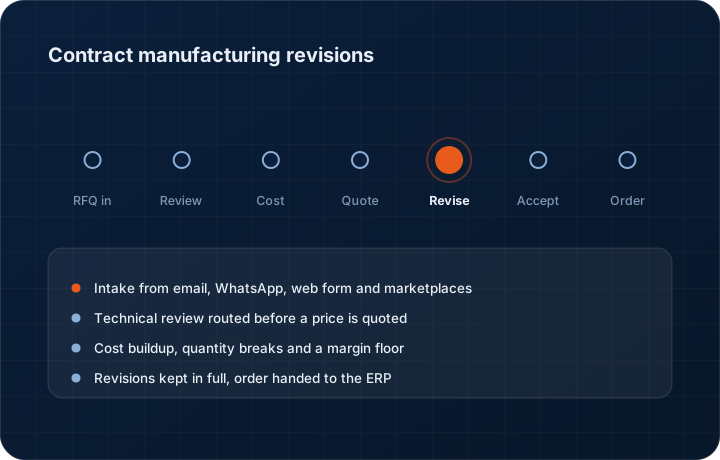
KanchanFlow is an RFQ-to-Order CRM for contract manufacturers. Every quote revision records the drawing revision it was priced against, purchase orders are matched on part and revision before anything reaches production, and the commercial record sits behind an immutable audit log from Professional upward.
Contract manufacturing is not job shop work at a larger scale. The economics are almost inverted. A job shop lives on new prints and one-off quantities; a contract manufacturer lives on the same twelve part numbers, released against a blanket, for four years. The commercial risk is not in winning the work. It is in the changes that arrive to work you already won.
A drawing revision, a quantity change, a forecast that never materialises, a material escalation across an eleven-month blanket. Each one is small. Each one is invisible until it is expensive.
The scenario
Thirteen days, one revision, one avoided run
This exact sequence is the single most common way a contract manufacturer loses money on work it already won.
| When | What happens | Effect |
|---|---|---|
| Day 0 | RFQ issued against print Rev C | Quote built and sent, Rev 0 |
| Day 6 | Customer engineering releases Rev D | Wall thickness changes, one hole pattern moves |
| Day 6 | Rev D reaches purchasing, not you | Nobody tells the supplier — this is the normal case, not negligence |
| Day 11 | PO arrives citing Rev D | Your quote priced Rev C. The prices are not comparable |
| Day 11 | Match raises the revision mismatch | Order is held in discrepancy, not passed to production |
| Day 12 | Requote as Rev 1 against print Rev D | Two operations added, price up 7 percent, agreed in one call |
| Day 13 | Corrected PO, order released | Material cut to the right print |
Without the match at day eleven, the shop cuts material to Rev C, ships parts that fail incoming inspection, and absorbs the scrap plus an expedited rerun. With it, the whole event is a phone call and a seven percent price adjustment agreed in advance.
What makes contract manufacturing different
Four structural facts
These are why a pipeline-shaped CRM fits a contract manufacturer badly.
- Repeat business
- 70 to 90 percent
- Unlike a job shop, most of your revenue is the same parts again. The commercial risk lives in changes, not in new work.
- Blanket orders
- Common
- One PO, twelve releases over a year. The price was agreed once; the material cost moves eleven times.
- Customer scorecards
- Quarterly
- On-time delivery, quality PPM and responsiveness, measured by your customer and used in sourcing decisions.
- Audit expectation
- Standing
- An automotive or aerospace customer will ask what you were quoting against and when. The answer has to be a record.
Blankets and releases
One agreement, twelve releases, eleven material moves
A blanket order is a price you agreed once against a cost that will not hold still.
- Blanket order held as an agreement — Total quantity, agreed price, validity window and any escalation clause on one record, with each release drawn against it.
- Release visibility — Quantity released to date against quantity committed, and the remaining balance, so nobody discovers an over-release at year end.
- Price validity clock — Where the agreed price was struck against a material cost, the current delta is shown so you know when to reopen it.
- Forecast against release — Customer forecast alongside actual releases, so the gap between what they said and what they ordered is visible per part.
The forecast-against-release comparison is the one contract manufacturers ask for second and value first. A customer forecasting 4,000 pieces a quarter and releasing 2,600 is not lying; their own demand moved. But if you bought material and reserved capacity against the forecast, that gap is your working capital, and it should be a number you can put in front of them.
Audit
Six things the commercial record holds
- Which print revision each quote revision was priced against
- Who changed a price, when, and the reason recorded at the time
- The exact quote document sent, and the delivery and open events after it
- The accepted revision, the signer, the timestamp and the countersigned PDF
- The PO as received, the fields that did not match, and how each was resolved
- Every field change on the order after handoff, with the user and time
The immutable audit log is a Professional feature; Enterprise adds a compliance dashboard. To be precise about what this is and is not: it is a tamper-evident record of the commercial transaction. It is not a quality management system, and no software makes a shop AS9100 or CMMC certified.
Honesty
When we are the wrong choice for a contract manufacturer
- You need full PPAP and APQP document packages generated and controlled — we hold PPAP as an Enterprise module, not as a quality management system
- You need statistical process control, gauge R&R or a full QMS — buy a QMS; we are the commercial record, not the quality record
- You need engineering BOM control with effectivity dates and ECO workflow — that is PLM and we connect to it rather than replacing it
- Your customer requires you to work inside their supplier portal end to end — you will be re-keying regardless, and we reduce that rather than eliminate it
- You are a single-customer contract manufacturer with one blanket order a year — the workflow here is more machinery than you need
What this is not
We are not built for enterprise multi-plant OEMs on SAP or Oracle, process manufacturers on recipe-based batching, distributors who need a warehouse management system, or shops requiring HIPAA / FDA validation. If that is you, Salesforce Manufacturing Cloud, NetSuite, or Global Shop Solutions is a better fit.
Questions contract manufacturers ask
Three things in sequence. Every quote revision records the print revision it was priced against, so the pairing is explicit rather than assumed. The PO match compares drawing revision as a hard field, so a PO citing Rev D against a quote priced on Rev C is raised before anything is cut. And the discrepancy has an owner and a resolution record, so it is closed rather than absorbed. None of that stops your customer issuing Rev D without telling you. It stops you finding out after the material is gone.
Related reading
Quote to order
Locked acceptance, seven-field PO matching and the discrepancy workflow.
Read moreDrawing revision management
How a print revision is held against a quote revision.
Read moreImmutable audit log
What is recorded, what cannot be edited, and what it does not claim.
Read moreJob shop CRM
The opposite economics: new prints, one-off quantities and a triage problem.
Read moreFabrication CRM
For shops pricing plate, cut, weld and finish as separate cost centres.
Read moreTrust Center
SOC 2 Type II, data residency, and the certifications we do not claim.
Read moreSee a live quote draft built from a real RFQ
Fourteen days, no credit card, sample data pre-loaded. If it does not fit your shop, we will tell you in the first call.
- Delaware LLC
- SOC 2 Type II
- USA Data Centers (AWS)