KanchanFlow vs Zoho CRM for manufacturing
A configurable general CRM can model almost anything, including an RFQ. The question is whether you want to own that configuration for the next eight years.
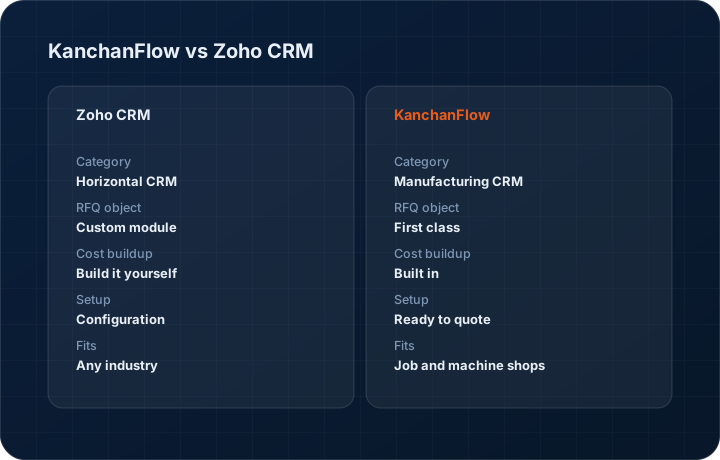
In short
KanchanFlow is a manufacturing-specific RFQ-to-Order CRM where the RFQ, the cost buildup and the quote revision chain ship as native objects. Zoho CRM is a broad, configurable general CRM at a lower entry price that can model the same things once someone builds and maintains them.
Zoho CRM is a capable product and a reasonable choice for a large number of businesses, including some manufacturers. This page is not an argument that it is bad. It is an argument about where configuration stops being cheaper than a purpose-built record.
Competitor pricing and capability here are described as of their published pricing page, September 2026. If something is out of date, tell us and it will be corrected at the next quarterly review.
Side by side
Eight categories, compared directly
| Category | KanchanFlow | Zoho CRM |
|---|---|---|
| Category | Manufacturing-specific RFQ-to-Order CRM | General-purpose configurable CRM |
| Pricing model | Published per user per month: $39, $49 and $99, three-user minimum, plus a published add-on catalogue | Published per user per month across four editions with a free tier for very small teams, as of their published pricing page, September 2026 |
| RFQ handling | A native object: multi-channel intake, unlimited line items, drawing revision, routing rules, qualification score, response clock | Buildable as a custom module with custom fields and a subform for line items. It works; you own it forever |
| Quoting depth | Four-column cost buildup, quantity breaks, margin floors per part family, structured BOM, unlimited revisions with a diff view | Quote document generation with line items and a total. Cost buildup and margin floors are custom development |
| Mobile | Native iOS and Android with offline capture, drawing photo capture and push quote approvals | Mature native mobile apps for a general CRM motion; not built around capturing a print on a shop floor |
| Integrations | Manufacturing-oriented: accounting, WhatsApp, marketplaces, logistics, ERP webhook, REST API and MCP server on Professional | Very broad, plus a large first-party suite covering accounting, inventory, support, forms and analytics |
| Ecosystem breadth | One product, deliberately narrow | A large suite; if you need many business applications from one vendor this is a real advantage |
| Who it is for | A shop where the work is won or lost on RFQ turnaround and quote quality | A manufacturer whose requirement is genuinely a flexible sales CRM, with someone in-house to configure and maintain it |
Honest
Where Zoho CRM beats us
- Price and a free tier — The entry cost is lower than ours and there is a free tier for very small teams. For a business testing whether it needs a CRM at all, that is a legitimate advantage.
- Breadth of suite — Accounting, inventory, support desk, forms, analytics and more from one vendor with one login. If you want to consolidate six tools, we cannot offer that and are not trying to.
- Configurability — Custom modules, fields, workflows, blueprints and scripting. Almost anything can be modelled. If your process is genuinely unusual, that flexibility is worth a great deal.
- Maturity and scale — Years of production use across every industry, deep administrative controls, and a large partner network who can implement it for you.
If your requirement is genuinely a flexible sales CRM, and you have someone in-house who enjoys configuring systems, the price and breadth advantage is real and we would be a worse purchase.
Honest
Where we beat Zoho CRM
- The RFQ ships as an object, not as a project — Line items with part, quantity, material, process, tolerance and drawing revision; routing on material and process; a response clock from arrival. Building that in a general CRM is weeks of configuration and then it is yours to maintain.
- Cost buildup with margin floors — Four columns per line, quantity breaks, floors per part family, and a pre-send scan for missing outside services and stale material prices. A quote template with a total is a different thing.
- Revision history that survives an argument — Unlimited revisions on every tier with a side-by-side diff. In our experience this is the specific capability that defeats general-CRM configuration projects, because modelling a revision chain properly is harder than it looks and nobody scopes it.
- Manufacturing defaults out of the box — Twelve process templates, role home screens for estimators and production coordinators, the Revenue Leakage Dashboard, dealer hierarchy and territory. None of that has to be designed by you first.
The real cost
Five things configuration debt does
- Every custom module is a thing your business now maintains, forever
- The person who built it usually leaves before the person who needs to change it arrives
- Upgrades and new platform features interact with custom scripting in ways nobody plans for
- Revision chains, cost buildups and approval routing are the three that consistently get under-scoped
- A half-finished configuration is worse than a spreadsheet, because it looks like a system
The revision chain is the one worth dwelling on. Modelling a quote that goes Rev 0 through Rev 4, where each revision keeps its own line items, prices, lead times and approval state, and where you can show a buyer a clean diff between any two of them, is substantially harder than it looks in a scoping meeting. It is also the thing shops reach for during a price argument, which is precisely when a half-built version fails.
Our position is not that configuration is wrong. It is that a manufacturer should configure the things unique to their business, and buy the things every shop needs.
What this is not
This is not an ERP, MRP, CAD, BOM, or advanced CPQ system — it manages customer RFQs, quotes, follow-ups, and order handoff.
Switching
What a migration actually involves
| Question | Answer |
|---|---|
| What moves | Accounts, contacts, open deals mapped to open quotes, historical quotes and accepted prices, attachments |
| What needs a decision | Custom modules you built — we map what fits our model and tell you plainly what does not |
| What we will not do | Recreate an arbitrary custom module one for one. If our model does not fit your process, better to know during the trial |
| Typical effort | One to three weeks depending on how much configuration exists |
| Parallel period | Two to four weeks running both, then stop the parallel |
| Trial | 14 days, no credit card, sample data pre-loaded |
We import historical quotes and accepted prices as records, which makes similar-part search and reorder prompts useful from day one. We will not reconstruct a cost buildup from a finished PDF — an invented breakdown is worse than none, because somebody will quote from it.
Questions about moving from a general CRM
Only if you have hit the specific walls. The usual three are quote revisions, cost buildup and approval routing on margin. If your quoting still happens in a spreadsheet next to the CRM, that is the signal. If the CRM is doing what you need and quoting is not your bottleneck, stay where you are — a migration you do not need is an expensive way to fill a quarter.
Related reading
Best CRM for manufacturing
Our self-published ranking of eight tools, with the bias stated up front.
Read moreCPQ vs CRM: what is the difference?
The category question underneath most of these evaluations.
Read moreRFQ management software
What ships as a native object rather than as a custom module.
Read moreQuote revision diff
The capability that most often defeats a general-CRM configuration project.
Read moreZoho Books integration
Running Zoho Books for accounting alongside this workflow.
Read morePricing
Our published prices, the add-on catalogue and the ceiling policy.
Read moreSee a live quote draft built from a real RFQ
Fourteen days, no credit card, sample data pre-loaded. If it does not fit your shop, we will tell you in the first call.
- Delaware LLC
- SOC 2 Type II
- USA Data Centers (AWS)