From an accepted quote to an order production can actually run
Acceptance that locks a revision, a purchase order matched line for line against it, and a handoff that carries the agreed numbers rather than somebody's retyping.
In short
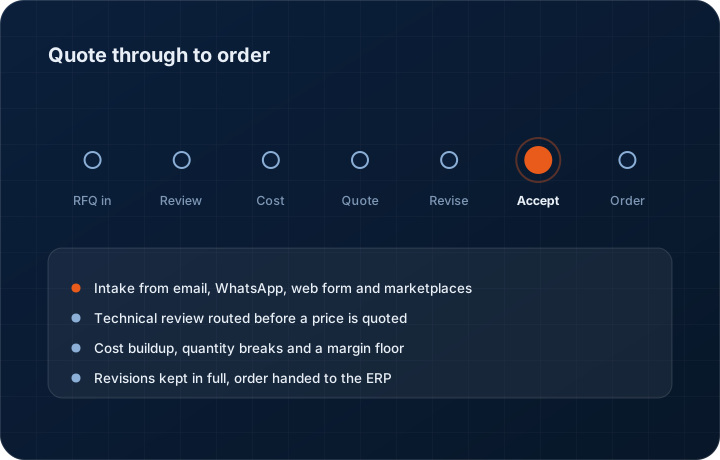
KanchanFlow is an RFQ-to-Order CRM that closes the quote-to-order gap: e-signed acceptance locks the agreed revision, purchase order capture matches the buyer PO line for line against that locked revision, and only a matched or explicitly resolved order is pushed to your ERP.
Between a quote a customer says yes to and an order your floor can run, there are three documents and at least two people who each assume the other checked. The quote, the acceptance, and the purchase order. The gap between them is where a shop agrees one price and bills another, or cuts material to the wrong print revision.
None of this is exotic. It is the plainest possible discipline: freeze what was agreed, compare what was ordered against what was agreed, and only send production what survived the comparison.
Acceptance
Signing freezes the revision
The moment a quote is accepted it stops being editable. Any change after that is a new revision with its own acceptance.
- Locked revision
- Signed = frozen
- The accepted revision cannot be edited afterwards. A change means a new revision and a new acceptance.
- Signer evidence
- Name, email, IP, time
- Held against the acceptance so the record survives a dispute two years later.
- Countersigned PDF
- Both sides
- The exact document that was agreed, stored on the quote rather than in a mail folder.
- Order created
- On acceptance
- An order record exists from the moment of signature, so it can be tracked before the PO arrives.
This is the smallest change with the largest effect. When the accepted revision is immutable, every later disagreement has a factual answer, and the phrase we agreed something different stops being an argument and becomes a document lookup.
PO matching
Seven fields, compared line for line
Not a header total check. Every line of the PO against every line of the accepted revision.
| Field | Match rule | Why it matters |
|---|---|---|
| Part number | Exact | A PO against a superseded part number is the most common single mismatch |
| Drawing revision | Exact | Rev C accepted, Rev B on the PO — stop before material is cut |
| Quantity | Exact | A 250 accepted against a 200 ordered changes the per-piece price |
| Unit price | Exact | Checked against the accepted revision, not against any earlier quote |
| Delivery date | Tolerance you set | A pull-in outside your quoted lead time raises rather than passes |
| Terms | Flagged difference | Net 30 quoted, Net 60 on the PO, escalated to whoever owns credit |
| Line count | Exact | A PO covering four of five accepted lines is a partial order, not a discrepancy to ignore |
Discrepancies
What happens when the PO does not match
A mismatch is a decision, and decisions want an owner and a record — not a blocked queue.
- Raised, not blocked — A mismatch does not stop the order. It puts it in a discrepancy state with the two values side by side and an owner assigned.
- One message to the buyer — The discrepancy view produces the email or WhatsApp message with the exact difference stated, so the buyer's own system can be corrected.
- Resolution recorded — Accepted as ordered, corrected PO received, or quote re-revised. Whichever way it goes, the decision is on the record with a name against it.
- Then the handoff — Only a matched or explicitly resolved order is pushed to production. That single rule removes most of what shops call a paperwork problem.
Handoff
What crosses into production
- Customer, ship-to address and buyer contact
- Line items with part number, drawing revision, quantity and agreed unit price
- Promised delivery date per line, with the expedite flag where one applies
- The accepted quote revision number and the PO number, both linked
- Outside-service operations quoted, so purchasing knows what to buy out
- Special instructions from the print or the buyer that were priced into the quote
The payload deliberately includes the outside-service operations that were quoted. Purchasing needs to know that the price assumed black oxide from a specific vendor at a specific rate, because buying it somewhere else at a different rate is a silent margin change nobody records.
Milestones come back the other way. A shop running a job-tracking system that reports operation completion can show inside sales where an order actually is, which removes the single most common interruption on a shop floor: a salesperson walking out to ask when something ships.
Boundaries
Where we stop
What this is not
This is not an ERP, MRP, CAD, BOM, or advanced CPQ system — it manages customer RFQs, quotes, follow-ups, and order handoff.
We do not schedule the order, we do not allocate it to a machine, we do not run an MRP pass against it, and we do not hold inventory. The order leaves us the moment it is matched and confirmed. What stays with us is the commercial record behind it — the RFQ it came from, every revision, the acceptance and the PO — so that when a question is asked eighteen months later there is an answer.
Questions about quote to order
Quote to cash is the whole cycle ending in a collected payment. Quote to order is the front half: getting from an issued quote to a confirmed, matched, production-ready order. In a job shop the front half is where the errors are created and the back half is where they are discovered. We concentrate on the front half because that is where a fix is still cheap.
Related reading
Quote to cash
The full eleven-stage cycle and an honest map of who owns which stage.
Read moreQuote management software
The open quote book before acceptance: ageing, follow-up, expiry and win/loss.
Read morePO OCR and matching
Extraction accuracy, the confirm step and the discrepancy view.
Read moreOrders
The order record, milestones and the ERP handoff payload.
Read moreE-signature
Signature evidence, the locked revision and the countersigned document.
Read moreContract manufacturing CRM
Where revision control between quote and PO matters most.
Read moreSee a live quote draft built from a real RFQ
Fourteen days, no credit card, sample data pre-loaded. If it does not fit your shop, we will tell you in the first call.
- Delaware LLC
- SOC 2 Type II
- USA Data Centers (AWS)