Custom manufacturing CRM for a business whose quote is a project
Ninety engineering hours to produce a bid, a one-in-five win rate, and a negotiation that runs nine months across two buyers and three specification changes. The front end of this business costs more than most owners have ever measured.
In short
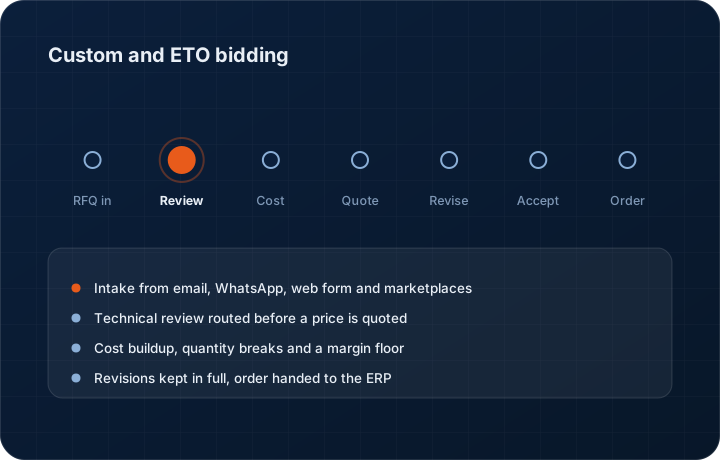
KanchanFlow is an RFQ-to-Order CRM for custom and engineer-to-order manufacturers. It logs engineering hours against each bid so the real cost of selling is visible, holds assumptions and exclusions as structured records that carry into every revision, and keeps a multi-month negotiation on one auditable thread.
Custom manufacturing has an accounting blind spot the size of a department. The bid is produced by engineers, and engineering time sits in overhead, so the cost of selling never appears as a cost of selling. A business can spend a quarter of a million dollars a year losing bids and describe it internally as being busy.
Everything else follows from that. If bids are free, you bid on everything. If you bid on everything, your engineers are the bottleneck, your win rate falls, and your good projects are quoted by tired people at the end of a week spent on projects you were never going to win.
Bid economics
What the front end of a custom builder actually costs
A representative builder of special-purpose handling equipment. Change the numbers to yours; the structure holds.
- Bids per year
- 42
- A representative builder of special-purpose handling equipment with three engineers and one estimator.
- Engineering hours per bid
- 90
- Layout, preliminary BOM, four vendor enquiries on long-lead items, controls estimate, proposal writing.
- Selling cost per year
- About $360,000
- At a loaded $95 an hour. Almost none of it appears as a line anywhere in the accounts.
- Spent on losses
- About $290,000
- At a 21 percent win rate. This is the number that changes what a business chooses to bid on.
Nothing here is an argument for bidding less. It is an argument for knowing the number, so that the decision to spend ninety engineering hours on a project is made deliberately by somebody who can see what it costs.
Tiered bidding
Four levels of response, not one
The most common structural mistake in custom manufacturing is treating every enquiry as a full bid.
| Response type | Engineering effort | What it contains |
|---|---|---|
| Budgetary number | 2 to 6 hours | A range with clear assumptions, no layout, explicitly not a quotation |
| Concept bid | 15 to 25 hours | Outline layout, major assemblies budgeted, exclusions written properly |
| Full bid | 70 to 120 hours | Layout, preliminary BOM, vendor quotes, controls estimate, milestone schedule |
| Re-bid on a known project | 20 to 40 hours | Prior bid cloned, scope deltas priced, vendor quotes refreshed |
Recording which tier each enquiry received, and what each tier converts at, is how a business learns where its effort pays. Most builders discover that concept bids convert nearly as well as full bids on early-stage projects, which is a large amount of engineering time recovered.
Scope
Four disciplines that prevent most disputes
Custom manufacturing arguments are almost never about the price. They are about what the price included.
- Exclusions as structured lines — Foundations, site power, guarding, freight, installation labour, commissioning travel. Each a record that carries into every revision and prints on the proposal.
- Assumptions with owners — Customer-supplied items, access, working hours on site, approval turnaround. Each assumption names who is responsible if it turns out to be wrong.
- Options priced as alternates — The customer wants a price with and without the vision system. Alternates sit on the same quote rather than becoming three separate documents nobody can reconcile.
- Scope creep captured as a revision — Can you also include the guarding, asked casually in an email, becomes a priced revision rather than an assumption you discover at the factory acceptance test.
Long negotiations
Six things that move between bid and order
- Vendor quotes expire — a gearbox quoted in April is not a cost you hold in September
- Material escalation across a six to nine month decision window
- The buyer changes, and the new one reopens terms you had settled
- A budget cycle moves the project one quarter and the whole cost base with it
- A competitor's proposal reshapes the customer's specification mid-process
- Your own capacity picture changes, so the lead time you quoted no longer holds
Each of these produces a revision, and a nine-month negotiation routinely runs to eight or twelve. The diff between Rev 0 and Rev 11 is the story of the project, and it is what you use when a customer asks why a March number is a November number.
Vendor quote validity is the specific trap. Each bought-out line carries the vendor, their quoted price and the validity date, and expired vendor pricing is flagged before a revision is re-issued. Builders who skip this hand out a price built on costs that lapsed four months earlier, and find out at the purchase order.
Honesty
When we are the wrong choice for a custom builder
- You need project manufacturing: resource-loaded schedules, earned value, percentage-of-completion revenue recognition — buy a project-based ERP
- You need engineering BOM control with effectivity dates and a formal ECO process — that is PLM, and we connect to it on Enterprise rather than replacing it
- You need document control for approval drawings and submittals with customer sign-off workflow — that is a document management system
- You sell configurable standard products with option dependency rules — that is genuine CPQ territory and a configurator will beat us
- You bid two large projects a year — the discipline here is more machinery than the problem justifies
What this is not
We are not built for enterprise multi-plant OEMs on SAP or Oracle, process manufacturers on recipe-based batching, distributors who need a warehouse management system, or shops requiring HIPAA / FDA validation. If that is you, Salesforce Manufacturing Cloud, NetSuite, or Global Shop Solutions is a better fit.
Questions custom manufacturers ask
That page describes the mechanics of an ETO bid — the package, the cost tracking, the revision control. This page is about the business: how bid economics should change what you bid on, how to tier your bidding effort, which plan fits, and where we are honestly the wrong tool. If you want the mechanics, read that one. If you are deciding whether this fits your company, stay here.
Related reading
Engineer to order software
The mechanics of an ETO bid: the package, the cost tracking, the vendor quote clock.
Read moreQuote management software
Running a book of long-cycle quotes without letting any of them lapse.
Read moreApproval engine
Value thresholds and margin rules on a six-figure bid.
Read moreDistributor management software
For builders who sell configured equipment through a partner network.
Read moreContract manufacturing CRM
The opposite economics: repeat parts, blankets and revision exposure.
Read morePricing
Where structured BOM, alternates and the approval engine sit in the tiers.
Read moreSee a live quote draft built from a real RFQ
Fourteen days, no credit card, sample data pre-loaded. If it does not fit your shop, we will tell you in the first call.
- Delaware LLC
- SOC 2 Type II
- USA Data Centers (AWS)