Job shop software for forty RFQs a week and two estimators
Every job is a first article, every quote starts from a print, and the real constraint is not price — it is which eighteen RFQs you are quietly not going to quote this week.
In short
KanchanFlow is an RFQ-to-Order CRM built for job shops. It triages inbound RFQs against the work you actually win, puts the last accepted cost for a comparable part in front of the estimator, and runs a response clock from arrival — so the eighteen RFQs you cannot quote get a same-day no-bid instead of silence.
The defining fact of a job shop is that nothing repeats reliably. A print arrives, and somebody who knows your machines, your people and your material costs has to decide what it takes to make it. There is no catalogue to look it up in. Every RFQ is an estimating problem before it is a sales problem.
The second defining fact is arithmetic. Below is the week most shops of this size actually run, and the gap at the end of it is where the software has to earn its money.
The week
Forty in, twenty-two out
A representative 25-person job shop. Your numbers will differ; the shape rarely does.
- RFQs in
- 40 a week
- Across email, a web form, two marketplace listings and whatever a buyer texts to the owner.
- Estimators
- 2
- One of whom is also the shop foreman and loses two afternoons a week to the floor.
- Time per real quote
- 45 to 120 min
- Longer if the print is unclear, the material is unusual or an outside service needs a vendor quote.
- Capacity
- About 22 quotes
- Which means 18 of the 40 will not be quoted properly, and the choice of which 18 is currently made by whichever email is on top.
Nothing in this software adds estimating capacity. What it does is make the eighteen a decision rather than an accident, and shorten the twenty-two by putting cost history where the estimator can reach it.
Triage
Six paths an RFQ can take, decided in five minutes
Routing rules sort on material, process, part envelope, customer and completeness before anybody opens a print.
| RFQ type | Path | Estimating time |
|---|---|---|
| Repeat part, known customer | Quote from last accepted revision | 10 minutes |
| Similar part, known customer | Similar-part search, adjust the buildup | 25 minutes |
| New part, known customer | Full buildup | 60 to 120 minutes |
| New part, new customer, in our envelope | Full buildup after a credit check | 60 to 120 minutes |
| Outside our envelope or capability | No-bid with a recorded reason, same day | 5 minutes |
| Incomplete RFQ | Question back to the buyer, parked with a clock | 5 minutes |
The two five-minute rows at the bottom are where most of the recovered capacity comes from. A shop that clears its no-bids and its incomplete RFQs on the day they arrive gets back roughly a day a week of estimating time.
What makes a job shop different
Four things that change how the workflow has to work
- Every job is a first article — There is no catalogue and no standard cost. Every quote starts from a print, which is why similar-part history is worth more here than in any other shop type.
- The customer list is long and shallow — Two hundred accounts, of which fifteen produce most of the revenue and the rest order twice a year. Dormant-account detection matters more than pipeline stages.
- Quantities are small and variable — One-off, five-off, then a surprise fifty. Setup dominates the cost, so the quantity break table is the quote.
- Response time decides more than price — A buyer sourcing a one-off part is solving a problem today. The shop that answers first is frequently the shop that gets it.
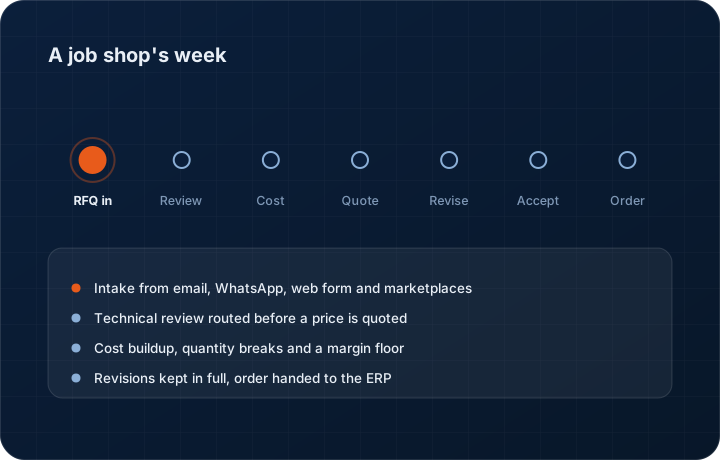
The workflow maps onto this directly. Intake pulls RFQs from four channels into one queue. Routing and qualification decide the path within minutes. The buildup carries quantity breaks because setup dominates a small-quantity price. Revision history is unlimited because a job shop argues about what Rev 2 said more often than it argues about a rate. And the reorder prompt matters because a job shop's repeat work is the only work with a known cost.
Tier fit
Which plan a job shop should actually buy
| Your shop | Tier | What you get for it |
|---|---|---|
| Under 10 people, one estimator, moving off spreadsheets | Starter, $39/user/month | Intake, routing, basic two-column quoting, unlimited revisions, three leakage metrics |
| 10 to 60 people, two or more estimators, real quote volume | Professional, $49/user/month | Four-column buildup, quantity breaks, margin guardrails, approval engine, PO OCR, all six leakage metrics |
| Multi-plant, ITAR or defence work, SSO required | Enterprise, $99/user/month + $2,000 platform fee | Multi-entity, immutable audit log, ITAR and Buy America modules, 2-hour SLA |
Most job shops with two or more estimators want Professional from the start, because margin guardrails and quantity breaks are the two features that pay for the difference within a quarter. A single-estimator shop moving off spreadsheets is genuinely well served by Starter.
Honesty
When we are the wrong choice for a job shop
- You run high-volume repeat production off a fixed catalogue — your cost is known, your problem is scheduling, and an ERP serves you better
- You need production scheduling, capacity planning and shop-floor data collection — we do none of those and are not building them
- You are a single-product manufacturer with a configurator and option rules — that is a CPQ problem, not an RFQ problem
- Your quoting is genuinely automated from geometry on a narrow process like flat laser cutting — a geometry-based instant quoter will beat us on that specific job
- You have one person, quoting four RFQs a month, and a spreadsheet that works — the three-user minimum makes us poor value for you
What this is not
This is not an ERP, MRP, CAD, BOM, or advanced CPQ system — it manages customer RFQs, quotes, follow-ups, and order handoff.
Questions job shop owners ask
No. Your ERP runs the floor: scheduling, routings, work in process, inventory, shop-floor data collection. It is generally poor at the customer-facing half — the RFQ that arrived this morning, the quote revision history, the follow-up nobody made. We take that half and hand the confirmed order to your ERP by connector or webhook. Shops that try to run quoting in a job shop ERP usually end up back in a spreadsheet within a year.
Related reading
RFQ management software
Intake from four channels, routing rules and the response clock in detail.
Read moreMachine shop CRM
The neighbouring case: a smaller shop where the owner is also the estimator.
Read moreManufacturing quoting software
The four-column buildup, quantity breaks and margin guardrails.
Read moreCut RFQ response time to three hours
Where the three days go, stage by stage, with the fixes ranked.
Read moreBest CRM for manufacturing
Our self-published ranking, including where our picks 4 to 6 beat us.
Read morePricing
Three tiers, per user, three-user minimum, 14-day trial without a card.
Read moreSee a live quote draft built from a real RFQ
Fourteen days, no credit card, sample data pre-loaded. If it does not fit your shop, we will tell you in the first call.
- Delaware LLC
- SOC 2 Type II
- USA Data Centers (AWS)