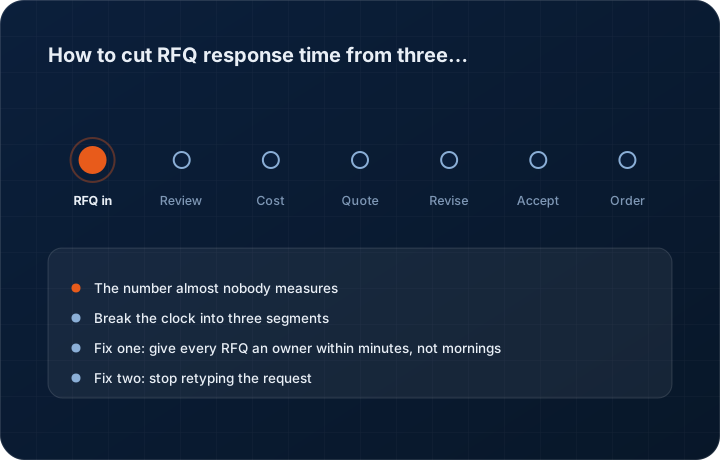
The number almost nobody measures
Ask a shop owner how long it takes to turn an RFQ around and you will usually get a number between one and two days. Ask them to prove it and the conversation changes, because the arrival time of an RFQ is a timestamp in somebody's mail client and the send time is a timestamp in a different one, and nobody has ever subtracted the two across a month of requests.
When shops do measure it properly, the number is nearly always worse than the estimate. Three to five days is the common range for a shop running two estimators on forty inbound requests a week. That gap between what a shop believes and what it does is not dishonesty. It is that the memorable RFQs are the ones handled fast, and the ones that sat for four days are memorable to nobody except the buyer who stopped waiting.
The reason to care is not tidiness. A purchasing agent placing a one-off part is solving a problem this week. They will typically send the same package to three or four shops and place the order with the first credible quote back, adjusting only if the price is out of line. Response time is not a service metric in that situation. It is the qualifying round.
Break the clock into three segments
A single response-time number is not actionable, because it hides three very different problems inside one figure. Split it into intake-to-assignment, assignment-to-priced, and priced-to-sent, and the answer is usually obvious within a week of data.
Intake-to-assignment is the time between the RFQ arriving anywhere in your business and it having a named owner. Assignment-to-priced is real estimating work. Priced-to-sent is approval, document assembly and the actual send.
In the shops we have looked at, the split is lopsided in a consistent direction. Intake-to-assignment is frequently the largest of the three and it is almost entirely queue time — the RFQ existing, unread, in a shared inbox. Assignment-to-priced is the segment everyone assumes is the problem and it is usually the smallest lever. Priced-to-sent is small in absolute terms but has a nasty tail when a margin exception needs an owner who is on the floor.
- Intake to assignment: often 40 to 60 percent of the total, almost all of it queue time
- Assignment to priced: the real estimating work, and the segment hardest to compress safely
- Priced to sent: usually short, with a long tail whenever an approval is needed
Fix one: give every RFQ an owner within minutes, not mornings
The single largest recoverable block of time is the period where an RFQ has arrived and nobody has decided who is dealing with it. In most shops that decision happens at a morning huddle, which means an RFQ arriving at 10:15 on Tuesday waits until Wednesday to be assigned even though nobody was busy.
Routing rules replace the huddle for the ordinary cases. Sort on material, process, part envelope and named customer: stainless weldments to the fabrication estimator, five-axis work to the machinist who quotes five-axis, anything past your table travel flagged before an estimator spends an hour on a job you cannot hold.
The exception cases still need a person, and that is fine. The point is that the ninety percent of requests with an obvious owner get one immediately, and the huddle is spent on the ten percent that genuinely need discussion. Shops that make this one change typically remove a day from the median before touching anything else.
Fix two: stop retyping the request
The second block of lost time is transcription. An RFQ arrives as an email with a PDF drawing and a spreadsheet of quantities. Somebody opens the spreadsheet, retypes the part numbers into a quoting sheet, and copies the quantities across. On a forty-line request that is twenty minutes of work that produces no value and introduces at least one error.
Extraction from the attachment removes most of it. The important design decision is that extraction produces a draft an estimator confirms, never a record the software commits on its own. On a clean tabular bill of material the extraction is usually complete. On a scanned print with handwritten annotations it will get the part number and miss the callout, and it should say so rather than guessing.
The measurable effect is smaller than the routing fix but it compounds, because it applies to every RFQ rather than to the ones that were queued. It also removes a specific and expensive error class: a quantity transposed at transcription and never noticed until the purchase order arrives at a different number.
Fix three: quote from your own history, not from a blank sheet
The assignment-to-priced segment is the one shops most want to attack and the one where naive speed-ups do damage. You cannot make an estimator think faster, and a quote produced in half the time by skipping the outside-service check is not a better quote.
What does work is starting from a reference. When a print arrives for a 4140 shaft, two inches in diameter, fourteen inches long, with a keyway and a ground journal, the estimator should see the last three comparable parts you quoted, what each was quoted at, what was accepted, and what the material and setup actually were. That is not an automatic price. It is the difference between an empty grid and a defensible starting point.
In practice this takes a ninety-minute estimate down to something closer to twenty-five, and the quality goes up rather than down, because the estimator is comparing against a real prior job rather than reconstructing an approach from memory at the end of a long day.
Fix four: make approvals reachable from the shop floor
The priced-to-sent segment has a short median and a long tail. Most quotes need no approval and go straight out. The ones that breach a margin floor or a value threshold wait for the owner, and the owner is usually on the floor, at a customer, or under a machine.
A quote sitting on a desk waiting for a signature is the most annoying form of delay because the work is already done. Push the approval to a phone with the quote, the breached rule and the estimator's written reason attached, and the decision happens in the aisle between two setups. Fifteen seconds instead of a day and a half.
There is a discipline point attached. An approval rule that fires on most quotes will be ignored within a fortnight, and an ignored rule is worse than no rule. Four rules cover the exceptions worth catching: margin below the floor for that part family, total above a value threshold, a new customer with no credit history, and a lead time beyond what you can hold.
Fix five: decline faster
The uncomfortable arithmetic is that a two-estimator shop receiving forty requests a week cannot price forty requests properly. Something between eighteen and twenty-two of them will not get a real quote. The only question is whether that is a decision or an accident.
Made deliberately, a same-day no-bid costs five minutes and buys back an afternoon. It also does something counterintuitive: it protects the relationship. A purchasing agent with a part to place is running their own clock, and a fast, honest decline lets them move on. A week of silence costs them a week and teaches them not to send you the next one.
Record the reason every time. Outside our envelope, lead time we cannot hold, price target below our floor, a customer we no longer serve. After a quarter the no-bid report is the cheapest market research a shop has, and it usually shows a pattern worth acting on — one buyer sending work you never win, or a process you keep declining that might be worth buying capacity for.
- Outside our machining envelope or capability
- Lead time inside our current backlog for that machine group
- Target price below our margin floor for that part family
- Incomplete package, and the buyer did not answer the technical question
- Customer on credit hold or outside the terms we accept
What three hours actually looks like
Three hours is not a target for every request and it is not achieved by working faster. It is achieved by sorting the requests into the ones that can be answered from history and the ones that need real work, and answering the first group immediately.
A repeat part from a known customer, quoted from the last accepted revision with a check on current material cost, is a twenty-minute job that should leave the same morning. A similar part with a reference buildup to adjust is under an hour. A genuinely new part in a difficult material with three outside operations is a day and should be, and pretending otherwise is how shops win work they lose money on.
The honest headline is that the median moves from days to hours while the hardest quotes take exactly as long as they always did. That is the right outcome. Compressing the estimating on a complex part is not a productivity gain, it is a pricing risk.
Measure it weekly and split it by channel
Once the clock is running from arrival rather than from when somebody noticed, look at the median weekly and split it two ways: by estimator and by intake channel.
The estimator split is a coaching tool, not a scoreboard, and it should be handled that way or people will start gaming the timestamps. The channel split is more immediately useful. Shops routinely find that email RFQs are answered in a day and web form submissions sit for four, because the form sends a notification to an address nobody treats as urgent.
That kind of finding is worth more than any software feature, and you cannot see it without measuring from arrival. It is also the reason to run the clock from the moment a request enters the business rather than from the moment it enters your quoting system — otherwise the number improves the day you buy software and none of the delay has actually gone anywhere.
The order to do this in
Routing first, because it is the largest block and the cheapest to change. Same-day no-bid discipline second, because it recovers estimating capacity immediately and costs nothing. History-based quoting third, because it needs some data behind it before it pays. Extraction fourth. Mobile approvals last, because the tail they fix is real but narrow.
None of this requires buying anything to start. A shop with a shared inbox and a whiteboard can implement routing rules and a same-day no-bid policy on Monday. What software adds is that the clock runs by itself, the rules apply without anybody remembering them, and the history is reachable from the quoting screen instead of living in a folder of PDFs.
If you take one thing from this: measure from arrival, not from assignment. Every improvement described here is invisible unless the clock starts when the buyer pressed send.