Customer-exclusive parts, tooling and drawings
This feature does not exist. The intent is to mark a part as belonging to one customer — their tooling, their print, their part number — so it can never be quoted to anyone else. Wave 2, no committed date.
In short
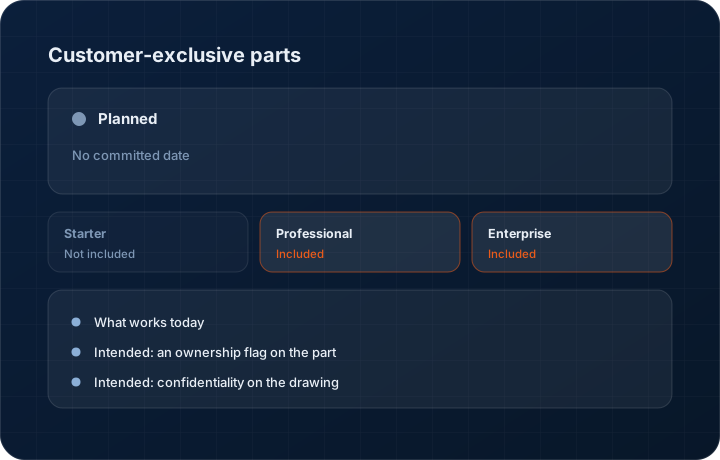
Customer-exclusive parts are not built in KanchanFlow. The intent is an ownership flag on the part record marking tooling, drawings and geometry as belonging to one customer, excluded from similar-part search for every other account. It is a Wave 2 item with no committed date, and nothing on this page is available today.
Where this actually stands
Almost every contract manufacturer holds parts that are not theirs. The customer paid for the tooling, the print carries their title block and their drawing number, and the part exists only because they asked for it. The obligation that comes with that is usually written into a supply agreement in one sentence and then managed entirely by the memory of whoever has been at the shop the longest. It survives until that person retires, or until a new estimator pulls up a similar job to price a new enquiry and finds a fixture, a routing and a price that belong to somebody else's customer.
The exposure is not theoretical. A shop quoting a new prospect off the routing of a proprietary part is quoting somebody else's development spend, and a print with another customer's title block sent out as a reference is a confidentiality breach with a name and a date attached to it. Neither is malicious. Both come from a system that treats every part in the database as equally available to whoever is quoting today.
What is planned is an ownership flag on the part record and the consequences that follow from it. The part is owned by one account. Its drawings are marked confidential to that account. Its tooling is recorded as customer-owned, with the tool number, who paid for it and where it physically sits. And the part is excluded from similar-part search results for every other customer, so it cannot be used as a reference price or a routing template for anyone else. The exclusion is the part that matters most, because search is exactly where the accident happens.
The interesting case is a second customer arriving with the same geometry, which happens more often than people expect — two OEMs buying from the same design house, or a part that is genuinely commodity apart from the print it arrived on. The intent is not to refuse the work. It is to make sure the second quote is estimated from scratch, on the second customer's own drawing, without inheriting the first customer's routing, tooling or price. The estimator would be told that a match exists and that it is restricted, without being shown the restricted record. Knowing that a similar part is off limits is useful. Seeing the part you are not allowed to see is not.
Nothing above is built. There is no ownership flag, no confidentiality marking on drawings and no search exclusion today, on any tier. It sits in Wave 2 with no committed date, and we are not going to publish a quarter for it just to make the page look decisive. What exists now is described in the next section, honestly.
Capabilities
What this would cover if we build it
What works today
Parts, drawings and revisions attach to the customer they were quoted for, and role-based permissions control who inside your shop can open a record at all. What does not exist is any concept of a part being owned by a customer, or of a drawing being confidential to one account.
Intended: an ownership flag on the part
A part marked as belonging to one account, so the relationship is a property of the record rather than something two people remember. Everything else in this list follows from that one flag.
Intended: confidentiality on the drawing
Prints carrying another company's title block marked as confidential to that customer, so they cannot be attached to a quote for a different account or sent in a share link by accident.
Intended: customer-owned tooling recorded
Tool number, who paid for it, where it is stored and which parts run on it. Customer-owned tooling is an asset you hold on somebody else's behalf, and it should be findable when they ask for it back.
Intended: exclusion from similar-part search
The similar-part search that Professional and Enterprise run on AI credits would skip restricted parts for every account except the owner. Search is where the accident actually happens, so this is the part of the idea that carries the weight.
Intended: a restricted-match signal without disclosure
An estimator would be told that a match exists and is restricted, and shown nothing about it. Enough to stop them assuming the part is new, not enough to leak what it is.
What it would never be
Not a legal NDA register, not an ITAR or export-control regime, and not a substitute for the confidentiality clause in your supply agreement. Enterprise carries ITAR handling and an immutable audit log for controlled work; this would be a commercial hygiene flag, nothing more.
Step by step
Where the work stands
There is no workflow to walk through yet. This is what the current position actually is.
- 1
Nothing works yet
There is no ownership flag, no drawing confidentiality marking and no search exclusion. A part quoted for one customer is visible to anyone in your workspace with permission to see parts at all.
- 2
What you can do in the meantime
Use role-based permissions to limit who can reach part and drawing records, keep customer-owned tooling in a named list somebody actually maintains, and make the confidentiality rule an explicit line in your estimator onboarding rather than folklore.
- 3
Why it sits in Wave 2
Wave 1 is the RFQ record, the cost buildup, approvals and the dealer channel. Each of those changes what a shop can do. This changes what a shop can accidentally do, which matters, but not before the work that earns the quote.
- 4
What would have to be decided first
Whether ownership is a flag on the part or a relationship that can cover several accounts, how a second customer's identical geometry is handled in the data model, and what an estimator is allowed to be told about a restricted match. Those are design questions we have not settled.
- 5
The status would change here first
If it enters development it gets a milestone and a progress figure on this page, and a changelog entry when it ships. Until then it stays planned, with no date and no index.
What this is not
This is not available today on any tier, and it would never be an export-control or NDA management system — it is a commercial confidentiality flag on a part record, not a compliance regime.
This is not an ERP, MRP, CAD, BOM, or advanced CPQ system — it manages customer RFQs, quotes, follow-ups, and order handoff.
Tier availability
What you get on each plan
These rows come from the same feature matrix the pricing page publishes. If the two ever disagree, the matrix is wrong and we fix it.
| Plan | Availability |
|---|---|
| Starter | Not built — no tier assignment. |
| Professional | Not built — no tier assignment. |
| Enterprise | Not built — no tier assignment. |
Starter is $39 per user per month, Professional $49, Enterprise $99 plus a $2,000 monthly platform fee. Annual billing is 17% lower. See the full matrix.
Interface
What it looks like
No screenshot. There is nothing built to capture.
We do not publish mockups of unbuilt features as if they were interface captures.
No screenshot. Part records, drawing revisions and role-based permissions are live today and are shown on their own pages.
Placeholder retained so this page's structure matches every other feature page.
Screenshots are described rather than mocked up. Captures are taken from the build current at the date shown in the changelog, on a sample workspace.
Questions about customer-exclusive parts
No. There is no ownership flag on any tier. Parts and drawings attach to the customer they were quoted for, and role-based permissions control who can open a record, but nothing stops a part from being used as a reference for another account.
Related features
Drawing revision management
Drawing revision management with AI spec extraction
Read moreCustomer 360
Customer 360 with plants and stakeholder mapping
Read moreContract and customer price lists
Contract and customer price lists with effective dates
Read moreImmutable audit log
Immutable audit log for compliance-driven manufacturers
Read moreWhat's shipping today
All 47 features grouped by status on one page, with the newest releases alongside.
Read moreSee a live quote draft built from a real RFQ
Fourteen days, no credit card, sample data pre-loaded. If it does not fit your shop, we will tell you in the first call.
- Delaware LLC
- SOC 2 Type II
- USA Data Centers (AWS)