Google Forms for Manufacturing
Turn an RFQ request form into structured leads, including the drawing file the customer uploaded, without anyone watching a spreadsheet.
In short
KanchanFlow, the RFQ-to-Order CRM, watches a Google Form's responses and creates a lead or an RFQ for each submission, carrying uploaded drawings and specification files across as attachments. It is the cheapest way to put a real RFQ request form on a shop's website without building anything.
Plenty of shops already have a quote request form built in Google Forms, usually because somebody needed one on a Friday afternoon and it was the fastest thing available. It works perfectly well as a form. The problem is what happens next: the responses sit in a spreadsheet that somebody is supposed to check, and on a busy week nobody does.
This connector keeps the form and removes the spreadsheet watching. Each response becomes a lead, or directly an RFQ if you map it that way, with the file upload question turned into a real attachment on the record. The estimator gets the drawing without downloading it from Drive and re-uploading it.
- Status
- Live in production
- Category
- Lead source
- Plan availability
- All tiers — Starter includes one selectable lead source; Professional and Enterprise include unlimited
- Sync cadence
- Every 5 minutes; a manual Sync now is available on the connector page
Field by field
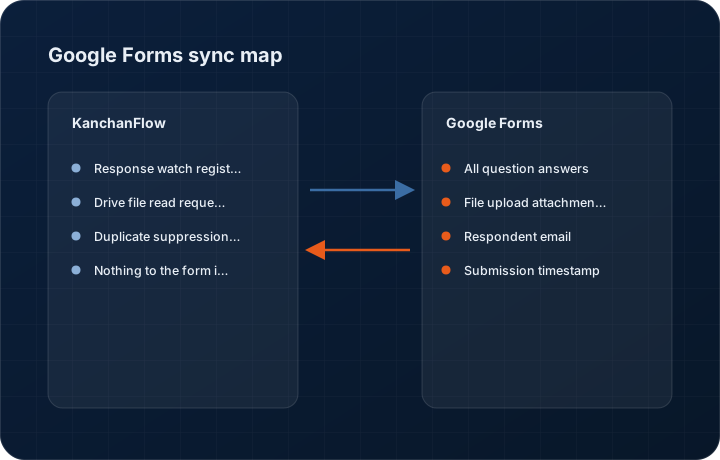
What syncs, in both directions
These are the actual fields that move. Anything not on these two tables does not sync, and we would rather write that down than let you assume it does.
KanchanFlow → Google Forms
What we write out when a record moves forward.
| Field | What we send |
|---|---|
| Response watch registration | We register a watch against the selected form so new responses are picked up, which is the only object we create in your Google account. |
| Drive file read request | For each mapped file upload answer we request that specific file from Drive by ID, and nothing else in the account is read. |
| Duplicate suppression key | The Google response ID is stored against the lead so a replayed response updates rather than duplicating the record. |
| Nothing to the form itself | We never edit the form, add or reorder questions, change its settings, or write anything to the linked response spreadsheet. |
Google Forms → KanchanFlow
What comes back onto the customer, quote or order record.
| Field | What we read |
|---|---|
| All question answers | Every question on the form, mapped to CRM fields you choose. Short answer, paragraph, multiple choice, checkbox, dropdown, date and linear scale are all supported. |
| File upload attachments | Files uploaded through the form's file question are fetched from Drive and attached to the lead or RFQ, which is the part that makes this connector worth having. |
| Respondent email | Where the form collects it, used as the primary dedupe key and as the reply-to for the acknowledgement. |
| Submission timestamp | The response time, which the response clock runs from. |
Sync cadence. Every 5 minutes; a manual Sync now is available on the connector page. Every record also carries a Sync now control, and the last successful sync time is shown on the record so nobody works from a number of unknown age.
Figures
What this looks like in the product
We do not ship stock imagery or mocked-up screens. These three figures describe the exact shots a designer must capture from a live workspace, each carrying a visible date stamp and recaptured at every quarterly re-test.
Capture date required. Capture the genuine picker. Date stamp required; form names may be blurred.
Capture date required. Capture with a real multi-question RFQ form. Date stamp required.
Capture date required. Capture with a genuine CAD file attachment present, not a placeholder document. Date stamp required.
11 steps
Setting it up
Written for the person who will actually do it, in the order they will do it. Nothing here assumes you have done this before.
- 1Identify the Google account that owns the form. Ownership matters; edit access alone is not sufficient for the file upload path.
- 2In KanchanFlow, open Settings, Integrations, Google Forms and click Connect.
- 3Authorise with the owning Google account. We request read access to forms and read access to the specific Drive files uploaded through them.
- 4Select the form to connect. One connector binding handles one form; connect several bindings if you run separate forms for RFQ and general enquiry.
- 5Choose whether responses create a Lead or an RFQ directly. RFQ is right if your form asks for part, quantity and drawing; Lead is right for a general contact form.
- 6Map each question to a CRM field. Take the time to map quantity and material properly, because those two drive routing and the RFQ Agent's first pass.
- 7Map the file upload question to attachments. Without this, files stay in Drive and the estimator will not see them.
- 8Set the dedupe rule to respondent email, and decide whether a repeat submission from the same email updates the existing lead or creates a new one. For RFQ forms, a new record is usually correct because it is a new job.
- 9Configure routing by material or product line if the form asks, otherwise round robin.
- 10Enable the acknowledgement email so the customer knows the request landed. Silence after submitting an RFQ form is the most common complaint buyers have about shops.
- 11Submit a test response including a file upload and confirm the attachment arrives on the record.
Honest ceilings
What this integration cannot do
Every connector has limits. You will find these in week three whether or not we write them down, so we write them down.
- The file upload question requires the respondent to be signed in to a Google account. Many industrial buyers are not, and they will hit a sign-in wall on your form. This is Google's behaviour and there is nothing we can do about it.
- Uploaded files live in the form owner's Drive and count against that account's storage quota. If the quota fills, uploads fail at the form, not at our connector.
- We poll every five minutes rather than receiving a push, so a response can be up to five minutes old when it reaches the CRM.
- Changing a question's text in Google Forms breaks its mapping, because Google identifies questions by ID and a rewritten question is often a new ID. Responses still import; that field arrives unmapped until someone fixes it.
- Google Forms offers no server-side validation you can rely on, so expect malformed phone numbers and quantities typed as words. We import what was submitted rather than silently correcting it.
- There is no spam protection on a public Google Form. If your form URL gets scraped you will receive junk, and the only real remedy is moving to a form with a CAPTCHA.
From the quarterly re-test
Errors you will actually hit
Each of these was reproduced deliberately during testing. The wording is the error as the system reports it, not a paraphrase.
| Error | Likely cause | Fix |
|---|---|---|
| File upload question shows no attachment on the record | The mapping for that question is not set to attachments, or the connected Google account cannot read the uploaded file. | Set the mapping, then confirm the connected account is the form owner. Uploads are stored in the owner's Drive and a non-owner may lack access. |
| A field stopped populating after the form was edited | The question was rewritten and Google issued a new question ID. | Reopen field mapping and re-map the question. The connector shows unmapped questions at the top of the list for exactly this reason. |
| Responses stop importing entirely | The Google OAuth grant was revoked, or the form owner's account was suspended. | Reconnect from the connector page with the owning account. Responses submitted during the outage import on reconnection because they remain in the response sheet. |
| Junk submissions flooding the lead inbox | The public form URL is being hit by a bot. | Restrict the form to signed-in users, or move to a form platform with CAPTCHA such as Typeform. We can filter on keywords but that is a poor substitute for real protection. |
| Quantity imports as text and breaks RFQ creation | A respondent typed a quantity as words or with a unit inside the same field. | Change the form question to a short answer with number validation, and set the connector to route unparseable quantities to a review queue rather than failing the import. |
Questions people ask about the Google Forms integration
Yes. If your form asks for part, quantity and a drawing, map it to create an RFQ rather than a lead and it will arrive in the estimating queue ready to work.
Related integrations
Typeform
Take a conditional RFQ intake form, complete with uploads and logic jumps, straight into the estimating queue.
Read moreMeta Lead Ads
Pull Facebook and Instagram lead form submissions into the pipeline in seconds, with campaign, ad set and ad recorded against every lead.
Read moreGmail two-way sync
Every RFQ email, drawing attachment and quote reply threads onto the right record without anyone forwarding anything.
Read moreKeeping this page true
This connector was last tested end to end on 2026-08-27 against a live sandbox: fresh authorisation, an outbound write, an inbound read checked field by field, and the failure paths above triggered deliberately. It is re-tested every quarter and the date on this page changes when it is. Read how we test integrations, or see what is shipping today.
See a live quote draft built from a real RFQ
Fourteen days, no credit card, sample data pre-loaded. If it does not fit your shop, we will tell you in the first call.
- Delaware LLC
- SOC 2 Type II
- USA Data Centers (AWS)