Dealer and territory exclusivity with channel-conflict rules
Two dealers, one customer, one phone call to you. Exclusivity written down as a rule with a date on it, so the answer is the same whoever asks and whoever is in the room.
In short
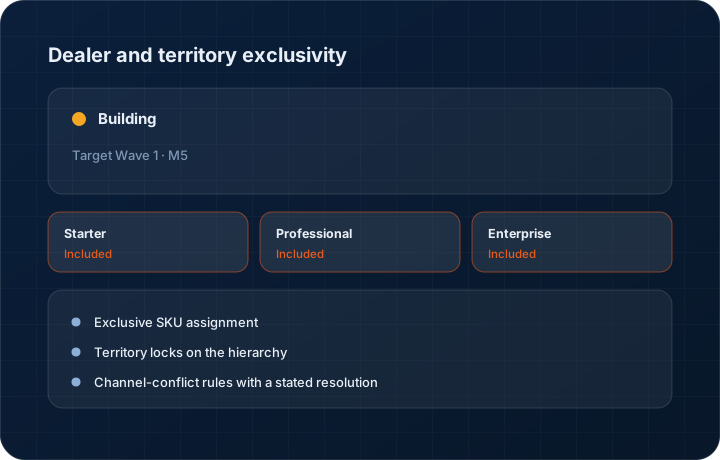
Dealer and territory exclusivity in the KanchanFlow RFQ-to-Order CRM records which channel partner holds which SKUs and which territories, and applies channel-conflict rules when two dealers register the same customer. It extends the live dealer records and the territory tree, and is targeted at Wave 1 Milestone 5 alongside Dealer 360.
What it is
Channel conflict is not an abstract governance problem. It is a Tuesday morning phone call from a distributor who has just found out that the account he has been developing for four months was quoted last week by another of your dealers at a lower number, and it usually ends with one of them going quiet on you. What makes it expensive is not the argument, it is that the answer depends on who you ask, and both dealers genuinely believe they are right because nothing was ever written down in a place both of them could see.
Exclusivity is the part that gets written down. A dealer holds named SKUs or product families, or holds a territory node, or both, between two dates. Where a right is exclusive, nobody else in the channel may be quoted for that combination — and the rule is visible to your inside sales desk at the moment they are about to break it, not in a distributor agreement in a drawer. Where the arrangement is non-exclusive, that is recorded too, because ambiguity is what produces the phone call.
Customer registration is the other half. A dealer registers a customer they are working; the registration carries a date, a scope and a lifespan. When a second dealer registers the same customer, the rule decides: first valid registration holds it for the protection period, the second dealer is told immediately rather than three months later, and if you want the case escalated to a human it goes to a named person with both registration dates, both pipelines and the territory position in front of them. The one thing it does not do is fail silently and let both partners keep spending money.
The structure this rides on is already there in shape. Channel partner records are live today. The five-level dealer hierarchy, the seven-level territory tree and the dealer portal are Professional and Enterprise capabilities, and Dealer 360 is in development against Wave 1 Milestone 5. Exclusivity is the rule layer on top of them, and it inherits that milestone rather than carrying a separately committed date of its own.
We are deliberate about what exclusivity does not become here. It is not a legal agreement, and nothing in the software creates or terminates a distributor contract. It is not price control either — what a dealer pays sits on a contract price list, and who is allowed to sell is a different question from what it costs. Keeping those two records separate is what stops an exclusivity change quietly repricing a channel.
Capabilities
What it does
Exclusive SKU assignment
A part number, a product family or a whole line assigned exclusively to one partner between two dates. Anyone quoting that SKU to another partner is stopped in the quote, with the holder and the expiry date named.
Territory locks on the hierarchy
Exclusivity attaches to a node in the seven-level territory tree, so a partner can hold a state, a city or a route without holding the region above it. Rights roll down the branch unless a child node is explicitly carved out.
Channel-conflict rules with a stated resolution
Overlap between two partners is either allowed, warned on, or blocked, and which one it is is a rule you set rather than a judgement made in the moment by whoever picked up the phone.
Customer registration with a protection window
A partner registers an account they are developing. The registration has a start date, a scope and a lifespan, and it expires rather than lasting forever on the strength of one visit in 2026.
Duplicate registration handled at the moment it happens
When a second partner registers the same customer, the first valid registration holds for its protection period and the second partner is told at once, with the reason. Contested cases escalate to a named person with both registration dates, both pipelines and the territory position visible.
Direct-versus-channel visibility
House accounts and direct-sale carve-outs are recorded on the same structure, so your own sales team is subject to the same rules as the channel and a partner can see which accounts are carved out before working one.
Overrides with a record, not a back door
Where you decide to quote against an exclusivity, an authorised user can override and the override is logged with who, when and why. On Enterprise it lands in the immutable audit log. Nobody has to reconstruct the decision later from memory.
Step by step
How it works
The order these steps happen in matters more than the feature list above it.
- 1
Define what is exclusive
For each partner, record the SKUs or product families and the territory nodes they hold, whether each right is exclusive or non-exclusive, and the dates it runs between. Anything not recorded is open, and it says so rather than being assumed.
- 2
Set the conflict rule
Choose what happens on an overlap: allow it, warn the person quoting, or block the quote. Different product lines can carry different rules — a commodity line is often open while a configured machine is protected.
- 3
Partners register their customers
A partner registers an account through the portal with the opportunity they are working. The registration carries a scope, a start date and a protection period, so a claim on a customer has a shape and an end.
- 4
A second registration arrives
The rule runs immediately. The first valid registration holds for its window, the second partner receives the decision and the reason, and a contested case routes to your named channel manager with both partners' dates, pipelines and territory positions on one screen.
- 5
Quoting respects the position
When anyone — a partner or your own desk — starts a quote that crosses an exclusive right, the rule fires in the quote rather than in a report at month end. The holder, the expiry and the rule that fired are named on screen.
- 6
Rights expire and get reviewed
Exclusivity has an end date, and rights approaching expiry surface with the revenue and coverage behind them. A right that renews should renew on evidence of what the partner actually did with it.
What this is not
This is not a distributor agreement, and nothing here creates, varies or terminates a legal contract — it records the commercial position you have already agreed. It is not price control either: what a partner pays lives on a contract price list, which is a separate record from who is allowed to sell.
This is not an ERP, MRP, CAD, BOM, or advanced CPQ system — it manages customer RFQs, quotes, follow-ups, and order handoff.
Tier availability
What you get on each plan
These rows come from the same feature matrix the pricing page publishes. If the two ever disagree, the matrix is wrong and we fix it.
| Plan | Availability |
|---|---|
| Starter | Not available. Starter carries 25 basic dealer records with no hierarchy, no portal and a flat territory list. |
| Professional | Included, on the 5-level dealer hierarchy and the 7-level territory tree, with registration through the dealer portal. |
| Enterprise | Included, with custom hierarchy and territory structures, multi-entity roll-up and overrides recorded in the immutable audit log. |
Starter is $39 per user per month, Professional $49, Enterprise $99 plus a $2,000 monthly platform fee. Annual billing is 17% lower. See the full matrix.
Interface
What it looks like
Development build of a partner record showing exclusive SKUs, the territory nodes held, and the dates each right runs between.
Development build capture. Partner names and part numbers are sample data.
Development build of a duplicate customer registration, showing both partners' registration dates, pipeline and territory position with the rule that decided it.
Development build capture, not production.
Screenshots are described rather than mocked up. Captures are taken from the build current at the date shown in the changelog, on a sample workspace.
Connectors
Integrations this feature uses
Starter includes one accounting connector and one lead source; Professional and Enterprise include all of them. Browse every integration.
Questions about dealer and territory exclusivity
The first valid registration holds the account for its protection period and the second partner is told immediately, with the reason, rather than finding out after four months of work. If you have set the case to escalate, it goes to a named channel manager with both registration dates, both pipelines and the territory position on one screen.
Related features
Dealer 360
Dealer 360 with AI reorder prediction
Read moreChannel partner management
Channel partner management
Read moreTerritory management
Territory management, 7-level hierarchy
Read moreContract and customer price lists
Contract and customer price lists with effective dates
Read moreWhat's shipping today
All 47 features grouped by status on one page, with the newest releases alongside.
Read moreSee a live quote draft built from a real RFQ
Fourteen days, no credit card, sample data pre-loaded. If it does not fit your shop, we will tell you in the first call.
- Delaware LLC
- SOC 2 Type II
- USA Data Centers (AWS)